

1099 Mortgage Loans: Solutions for Self-Employed Borrowers
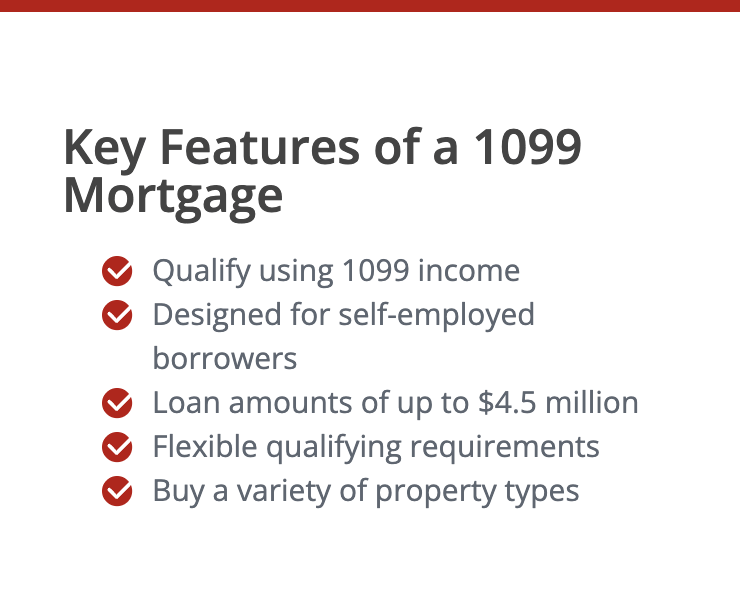
Get approved for a mortgage without W-2 income. 1099 mortgage loans are designed specifically for self-employed borrowers who need to qualify using their freelance or contractor earnings.






Featured In



Benefits
1099 Mortgage Loan Benefits

Qualify with 1099 income:
We can use 90-100% of your gross 1099 income to qualify you for a loan. Traditional lenders only look at net income after business deductions.

Continue making business deductions:
You don’t have to choose between lowering your taxes and qualifying for a mortgage. Your business deductions won’t hurt your loan approval.

Streamlined documentation:
The documentation process is more straightforward for self-employed professionals since you’re not working around conventional lending requirements.

High loan amounts:
You can qualify for loans up to $4.5 million based on your actual earning capacity, not just what shows up as net income on your tax return.
How it Works
What Is a 1099 Mortgage?
A 1099 mortgage is designed for self-employed individuals who struggle to qualify for traditional mortgages. Most lenders focus on net income after business deductions on your tax returns, which significantly reduces your qualifying amount even if you earn good money.
Instead, 1099 mortgage lenders use your 1099 forms from the past 1-2 years to verify income, often considering a higher percentage of your gross earnings rather than just what’s left after write-offs.
1099 loans are ideal for:
- Freelancers and independent contractors
- Gig economy workers
- Consultants paid on 1099s
- Real estate agents and commission-based earners
- Content creators and influencers
- Business owners without W-2 income
- Self-employed borrowers whose tax write-offs reduce qualifying income
- Anyone who receives 1099 forms instead of a traditional paycheck
How Lenders Calculate Income for 1099 Borrowers
Most lenders calculate qualifying income for 1099 borrowers using a gross income averaging formula. The gross 1099 income from the most recent one or two calendar years is added together and divided by 12 (for one year) or 24 (for two years) to produce a monthly qualifying figure. No tax return analysis is required.
The critical variable is whether a lender uses gross or net income. Conventional lenders use net income from Schedule C after business deductions, which reduces qualifying income by 30 to 50% for active 1099 borrowers with legitimate tax write-offs. A 1099 mortgage loan bypasses the deduction calculation entirely and uses gross 1099 income before deductions, preserving the full earning power of what was actually earned.
How Griffin Funding Calculates 1099 Income
Griffin Funding qualifies borrowers using 90 to 100% of gross 1099 income. The calculation depends on whether one or two years of 1099s are provided:
Example Income Calculation
A freelance marketing consultant earned $120,000 in gross 1099 income in 2024 and $144,000 in gross 1099 income in 2025. After filing, their CPA applied $52,000 in Schedule C deductions, leaving $92,000 in net taxable income on the 2025 return. Below is how two lenders evaluate the same borrower.
The same borrower qualifies for approximately $107,000 more in purchasing power through a 1099 mortgage. The deductions that reduce their tax bill have no effect on how their 1099 income qualifies under Griffin Funding’s program.
1099 Mortgage Requirements

Credit score:
620 minimum

Down payment:
10% minimum (may be higher based on credit score)

Self-employment history:
2 years in business (or 1 year with prior industry experience)

Reserves:
3-6 months of PITI for loans under $1.5M; 12 months for loans over $3M

Loan amounts:
$100,000 to $4.5 million
Debt-to-income ratio:
Typically 43% or lower
FAQ
Frequently Asked Questions
Your 1099 mortgage interest rate varies based on several factors, including your:
- Credit score
- Income
- Debt-to-income (DTI) ratio
- Market conditions
- Down payment amount
Similar to a self-employed home equity loan, rates for 1099 mortgages are typically higher than conventional or government-backed loans. This is due to additional risks that 1099 mortgage lenders take on when working with self-employed borrowers.
The minimum down payment starts at 10% for qualified borrowers. The exact amount depends on your credit score and overall financial profile. Borrowers with lower credit scores may need to put down 15-30%.
A 1099 self-employed mortgage makes sense if you:
- Have been self-employed for at least two years
- Receive most of your income through 1099 forms
- Struggle to qualify for conventional mortgages because business deductions reduce your net income.
This program is ideal for:
- Freelancers
- Independent contractors
- Gig workers, consultants
- Business owners who lack W-2 income
If you control when and how you work and receive 1099s instead of traditional paychecks, this loan is designed for you.
Yes. Depending on your documentation and income structure, you might also qualify for bank statement loans, asset-based loans, or P&L loans. Each program uses different documentation to verify your income and financial stability. If you already own a home, you can also explore a self-employed refinance to lower your rate or access equity.
It’s not hard when you work with a lender who specializes in self-employed borrowers. The main challenge is that traditional banks don’t understand how to properly evaluate 1099 income. You’ll need to provide more documentation than W-2 employees — including tax returns, 1099 forms, and profit and loss statements — but the process is straightforward with an experienced lender like Griffin Funding.
Both 1099 loans and bank statement loans serve self-employed borrowers who cannot qualify using tax returns or W-2s, but they use different documentation and are suited to different income structures. Use the table below to identify the better fit for your situation.
Many borrowers qualify for both programs. Griffin Funding can run both income calculations simultaneously and present the program that produces the highest qualifying income for your specific file.
Yes. You can use a 1099 mortgage to finance investment properties. The qualification requirements remain the same, though investment property loans typically require larger down payments (20-25% minimum) and may have slightly higher interest rates than primary residence loans. You’ll also need larger cash reserves.
A 1099 mortgage is a Non-QM home loan that qualifies self-employed borrowers, including gig workers, independent contractors, freelancers, and 1099 employees, based on their gross 1099 income rather than the net income shown after business deductions on their tax returns. Most lenders use net income for qualification, which dramatically reduces qualifying amounts for self-employed borrowers even when they earn good money. A 1099 mortgage uses your 1099 forms from the past 1 to 2 years to verify income, qualifying you on 90 to 100% of your gross earnings.
Here’s what that means in practice. Consider a real estate agent who earned $150,000 in gross 1099 commissions in 2025. Their CPA helps them claim $58,000 in legitimate Schedule C business deductions: vehicle and mileage, marketing, MLS fees, broker splits, E&O insurance, phone and software, continuing education, and the standard self-employment tax deduction. Their net income on the 1040 is $92,000. Two lenders look at the same agent. Here’s how they qualify.
| Calculation | Conventional Mortgage | 1099 Mortgage |
|---|---|---|
| Income source | Net income on tax return | 90% of gross 1099 income |
| Qualifying annual income | $92,000 | $135,000 |
| Qualifying monthly income | $7,667 | $11,250 |
| Max housing payment (43% DTI) | $3,297 | $4,838 |
| Approximate loan amount | ~$370,000 | ~$545,000 |
The same borrower qualifies for roughly $175,000 more in mortgage borrowing power through a 1099 mortgage.
The deductions that lower their tax bill no longer work against them when they want to buy a home. A 1099 mortgage works especially well for active gig workers and independent contractors whose business expenses and legitimate tax planning reduce their reported income enough to make conventional financing impossible.
Griffin Funding is the best 1099 mortgage lender for freelancers, independent contractors, and gig economy workers based on the following program terms, which are more favorable than most direct 1099 lenders in the market:
Every 1099 borrower at Griffin Funding works with a dedicated Senior Loan Officer experienced in self-employed income structures, not a generalist who treats 1099 income as a documentation exception.
Griffin Funding’s 1099 mortgage process requires no tax returns, no W-2s, and no pay stubs. Here is what to expect from application to closing.
- Gather your documents. Collect your most recent one to two years of 1099 forms from all income sources, two months of bank statements to verify your down payment funds and cash reserves, and a government-issued ID. If purchasing in an LLC or revocable trust, include articles of organization and operating agreement. No tax returns are required at any stage.
- Check your credit score. The minimum credit score for a 1099 mortgage at Griffin Funding is 620. A score of 700 or higher qualifies you for better rate pricing. Borrowers with a score of 740 or above access the best available terms, including the 10% down program for primary residences.
- Estimate your qualifying income. Add your gross 1099 income from the past one to two years and divide by 12 or 24 to produce a monthly figure, then apply 90% for a conservative qualifying estimate. A Griffin Funding loan officer can run this calculation for your specific file at no cost before you submit a full application.
- Submit your application. Complete Griffin Funding’s digital application in 10 to 15 minutes. A Senior Loan Officer will contact you within one business day to confirm your scenario, review your documents, and identify whether a 1099 loan or an alternative program produces the better outcome for your situation.
- Underwriting and appraisal. Griffin Funding orders an appraisal and completes 1099 income review. Because no tax return analysis is required, the underwriting process is more streamlined than conventional mortgage underwriting. Most 1099 loans move from application to clear-to-close in 14 to 30 days.
- Clear to close and fund. Once approved, you will receive a closing date and a final loan disclosure. Griffin Funding has closed 1099 mortgage loans in as few as 6 calendar days for borrowers who arrive with complete documentation.
Griffin Funding’s standard requirement is two years of self-employment history, consistent with most 1099 mortgage lenders. However, borrowers with one year of 1099 self-employment history may still qualify if they can document prior employment in the same industry or profession before transitioning to independent contractor work.
For example, a registered nurse who worked as a hospital employee for four years and recently shifted to per diem or travel nursing contracts can provide prior employment records to bridge the two-year requirement. A financial advisor who left a firm to launch an independent practice with an established client base is another scenario where a one-year exception may apply. Contact us today and a Griffin Funding Senior Loan Officer can evaluate your specific employment history and identify whether a program is available.
A 1099 mortgage requires significantly less documentation than a conventional loan. Griffin Funding requires the following:
- Two years of 1099 forms from all income sources (or 1 year with prior industry experience)
- Year-to-date income documentation such as invoices, contracts, or client payment records
- Two months of bank statements verifying down payment funds and cash reserves
- Government-issued ID such as a driver’s license or passport
- For purchases in an LLC or revocable trust: articles of organization and operating agreement
No tax returns, W-2s, pay stubs, or full bank statement history are required at any stage of the application or underwriting process.