

DSCR Loan Calculator

 Written by Bill Lyons
 Reviewed by Guy Troxler


KEY TAKEAWAYS
- Debt service coverage ratio (DSCR) measures a property’s cash flow versus its debt obligations.
- A DSCR of 1.0 indicates that a property is earning enough rental income to cover its debt, while a DSCR below 1.0 indicates that the property’s debts outweigh the rental income being generated.
- DSCR loans use a property’s DSCR rather than a borrower’s personal income to make a lending decision.
- Our free DSCR loan calculator can help you quickly estimate the DSCR of a given property and determine whether this type of mortgage is right for you.
Use this free DSCR loan calculator to estimate a rental property’s debt service coverage ratio, PITIA, monthly loan payment, and potential borrowing power for a purchase or refinance.

DSCR Loan Calculator
DSCR Calculator
Estimate your ratio before you apply: choose purchase, short-term rental, or cash-out refinance, enter the rent and the payment, and the calculator does the rest.
Want the full math? See how DSCR is calculated, with worked examples and what to do if your ratio comes up short.
This calculator provides an educational estimate, not a rate quote, loan offer, or commitment to lend. Final eligibility, documentation, pricing, DSCR treatment, LTV, reserves, and terms depend on underwriting and applicable program guidelines.
How to Use This Calculator
Select the transaction and rental strategy, then enter the qualifying rent, loan terms, and monthly expenses. The estimates update with each change.
Choose Your Scenario
| Selection | What to Choose |
|---|---|
| Transaction | Select Purchase for a new loan or Refinance for a property you own. |
| Rental Strategy | Select Long-term Rental or Short-term Rental. |
Enter the Property and Loan Information
| Field | What to Enter |
|---|---|
| Qualifying gross monthly rent | Enter the monthly rent supported by the lease or appraisal you expect the lender to use. Do not enter projected rent based on future improvements. For an early estimate, use the Free Rent Estimator . |
| Loan amount | Enter the amount you plan to borrow for the purchase or refinance. |
| Illustrative interest rate | Enter the interest rate you want the calculator to use when estimating the payment and DSCR. You can use a hypothetical rate to compare scenarios, but the result is not a rate quote. |
| Loan structure | Select a 15-, 20-, 25-, 30-, or 40-year term and choose an amortizing or interest-only payment. The interest-only option calculates the payment using only the interest due at the entered rate. Availability and qualification requirements depend on the loan program and complete borrower scenario. |
| Property taxes / month | Enter the property’s monthly tax amount. Divide the annual estimate by 12 if needed. |
| Insurance / month | Enter the monthly property-insurance amount. Do not include flood insurance if you enter it separately below. |
| HOA / month | Enter the monthly HOA or association dues. Use $0 if the property has none. |
| Flood insurance / month | Enter the monthly flood-insurance amount, if applicable. Use $0 if it does not apply. |
Review the Results
| Result | What It Shows |
|---|---|
| Estimated DSCR | Qualifying rent divided by PITIA, shown within the Fair, Good, Excellent, or Best range. |
| Estimated PITIA | Total principal and interest, taxes, insurance, flood insurance, and HOA dues. |
| Monthly loan payment | Principal and interest based on the selected term and payment type. |
| Estimated DSCR buying power | Illustrative loan amounts supported at a 1.25 and 1.00 DSCR. |
How DSCR Is Calculated
Griffin Funding calculates debt service coverage ratio using this formula:
DSCR = Gross Monthly Rental Income ÷ Monthly PITIA (Principal, Interest, Taxes, Insurance, Association dues)
PITIA includes principal and interest, property taxes, insurance, and homeowners association dues when applicable. A ratio of 1.00 means the gross rent exactly equals PITIA. Above 1.00, the property’s monthly rent exceeds its monthly expenses; below 1.00, the property’s income does not fully cover the monthly expenses.
DSCR Calculation Example
Suppose an investor finances $300,000 with a fully amortizing 30-year loan at an illustrative 7.00% interest rate. The property produces $3,000 in qualifying gross monthly rent.
| Monthly calculation | Amount |
|---|---|
| Principal and interest | $1,996 |
| Property taxes | $367 |
| Insurance | $167 |
| HOA dues | $120 |
| Flood insurance | $0 |
| Total PITIA | $2,650 |
| Gross monthly rent | $3,000 |
DSCR = $3,000 ÷ $2,650 = 1.13
A 1.13 DSCR means the property’s monthly rent is 13% higher than its monthly PITIA, placing it in the calculator’s
Excellent range, which includes ratios between 1.00 to 1.24.
Keep in mind that DSCR does not account for maintenance, management, utilities, repairs, vacancy losses, or other operating expenses, so it does not provide a complete measure of the property’s profitability.
DSCR Calculator Methodology
The calculator uses the loan amount, illustrative rate, term, and payment type to estimate the loan payment. It adds taxes, insurance, flood insurance, and HOA dues to calculate PITIA, then divides qualifying rent by PITIA. It also works backward from the inputs to estimate supported loan amounts at a 1.25 and 1.00 DSCR.
The calculation excludes maintenance, management, utilities, repairs, and vacancy. Appraisal and underwriting determine the final qualifying figures and terms.
What Counts as a Good DSCR?
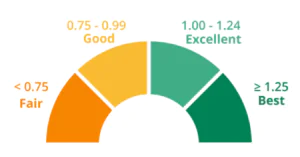
The calculator places the estimated ratio into four ranges
| Estimated DSCR | Calculator Range | What the result generally means |
|---|---|---|
| Below 0.75 | Fair | Requires closer review; reserves-based or no-ratio options may be available |
| 0.75 to 0.99 | Good | Rent doesn’t fully cover PITIA, but the loan may still qualify with sufficient reserves |
| 1.00 to 1.24 | Excellent | Rent covers PITIA; the property may qualify through standard DSCR options |
| 1.25 or higher | Best | Rent provides a larger cushion above PITIA and may support stronger pricing |
The labels explain the estimate but do not constitute approval or promise particular pricing. Many lenders look for at least 1.25, but Griffin Funding has no minimum DSCR requirement. Loans below 1.00 may qualify when reserves and equity support the transaction, and no-ratio programs are available.
In July 2026, Griffin Funding closed DSCR loans with ratios ranging from 0.70 to 2.23, including two below 1.00. Your ratio can affect pricing, down payment, and reserve requirements, but it is not the only part of the loan decision. Learn more about what is a good DSCR ratio.
Gross Rent vs. NOI: Why Calculators Produce Different Ratios
Not every lender uses the same DSCR formula. Griffin Funding divides the property’s gross qualifying rent by PITIA. Some lenders first subtract operating expenses and vacancy from gross rent, then use net operating income, or NOI, as the numerator.
An NOI-based calculation produces a lower ratio because it starts with less income.
For example, the example property above has a 1.13 DSCR using $3,000 in gross monthly rent. A calculator that first subtracts management, maintenance, or vacancy expenses will return a lower ratio even though the property, rent, and loan have not changed.
Before comparing calculator results, check whether each calculator uses gross rent or NOI. A calculator that uses NOI will usually show a lower DSCR for the same property.
How to Improve a Low DSCR
If the estimated ratio is lower than expected, focus on the inputs that affect gross rent or PITIA:
- Confirm the qualifying rent: Compare the current lease with the appraiser’s market-rent analysis. Depending on the property and program, the qualifying rent may not be the amount currently collected.
- Make a larger down payment: Borrowing less reduces the principal-and-interest payment the rent must cover.
- Test a longer loan term: Enter 40 instead of 30 in the Loan Term field to estimate how a fully amortizing 40-year payment would affect the DSCR.
- Review the estimated rate: A lower interest rate reduces the principal-and-interest payment.
- Check taxes and insurance: Confirm the property’s expected tax treatment and obtain an appropriate landlord-insurance estimate before relying on the result.
- Interest Only: Switch the payment type to interest-only to see how removing principal changes the ratio.
Current property owners may also consider a DSCR cash-out refinance or DSCR HELOC/HELOAN to access equity in a rental property.
Run Your Numbers With a Loan Officer
A calculator provides a useful first estimate. A loan officer can determine which rent figure, loan structure, and program apply to the property.
Griffin Funding offers DSCR loans from $100,000 to $4.5 million, with no universal minimum DSCR. Qualifying loans have closed in as few as six days, and the average closing time is 34 days. Borrowers qualify without tax returns, W-2s, pay stubs, or a personal debt-to-income calculation.
Need to run a different mortgage scenario? Explore Griffin Funding’s different mortgage calculators.
Find the best loan for you. Reach out today!
Get StartedFrequently Asked Questions
How do you calculate a DSCR loan? 
Do DSCR loans require 20% down?
What is the downside of a DSCR loan?
The calculated ratio does not measure the property’s actual profit because it excludes operating expenses. When weighing the DSCR pros and cons, compare the easier income documentation with the loan’s complete cost, reserve requirement, and prepayment terms.
Is it hard to qualify for a DSCR loan?
The lender will still review credit, liquidity, property eligibility, appraisal, rental income, and the proposed loan structure. Depending on the program, borrowers may also be able to get a DSCR loan through an LLC.
Does Griffin Funding use gross rent or NOI?
Can I calculate DSCR for a 40-year or interest-only loan?
Is DSCR calculated using actual rent or market rent?
Short-term rentals may use documented rental history or approved market data, depending on the program. Ask your loan officer which rent figure will apply before ordering the appraisal.

Bill Lyons is the Founder, CEO & President of Griffin Funding. Founded in 2013, Griffin Funding is a national boutique mortgage lender focusing on delivering 5-star service to its clients. Mr. Lyons has 25 years of experience in the mortgage business. Lyons is seen as an industry leader and expert in real estate finance. Lyons has been featured in Forbes, Inc., Wall Street Journal, HousingWire, and more. As a member of the Mortgage Bankers Association, Lyons is able to keep up with important changes in the industry to deliver the most value to Griffin's clients. Under Lyons' leadership, Griffin Funding has made the Inc. 5000 fastest-growing companies list six times in its 13 years in business. Follow his updates on LinkedIn.
 Outstanding Client Experience
 Specialized Lending Solutions
 Direct-to-Consumer Advantage
 We're Advisors, NOT Salespeople
 Effortless Digital Mortgage Platform
Featured In



Recent Posts
The rise of the five-house landlord: Wall Street blinked, small investors kept buying
In a single month, America’s biggest landlords cut their share of home purchases nearly in half. Firms t...

Mortgage rates hit 18% in 1981. Here’s how that compares with buying a home today
Borrowers shopping for a 30-year fixed mortgage in the fall of 1981 saw rates peak at 18.63% in the week of Oc...
Average home equity gains topped $200,000 in six states as renters faced heavy housing costs
A rising home value can mean two very different things on the same street. For an established homeowner, it ca...