

How to Finance a Home Renovation

 Written by Bill Lyons



Whether you’re upgrading a dated kitchen, adding square footage, or tackling overdue repairs, figuring out how to finance a home renovation is just as important as choosing the right contractor. Homeowners today have more financing choices than ever, from tapping into existing equity to taking out a personal loan.
- Best Ways to Finance a Home Renovation
- How to Choose the Right Home Renovation Financing Option
- Steps to Finance a Home Renovation Project
- Common Mistakes to Avoid When Financing House Renovations
- Finance Your Renovation Using the Right Strategy
- Frequently Asked Questions
Key Takeaways
- Home equity loans and HELOCs are among the most popular options for financing house renovations because they offer lower interest rates compared to many alternatives.
- Cash-out refinancing lets you roll renovation costs into your mortgage, potentially at a lower rate.
- Renovation loans like FHA 203(k) and Fannie Mae HomeStyle® allow you to finance both a home purchase and improvements in a single loan.
- Personal loans and credit cards can work for small projects, but they usually come with much higher interest rates.
- Choosing the right financing strategy depends on your available equity, project scope, and long-term financial goals.
Best Ways to Finance a Home Renovation
There’s no single best way to pay for home renovations because it depends on your financial situation, how much work you’re planning, and whether you have equity to leverage. Here’s a closer look at the most common options.
Home Equity Loan
A home equity loan provides homeowners with an upfront lump sum based on the amount of equity they’ve built in the property. You repay it in fixed monthly installments at a fixed interest rate, which means your payments stay predictable from month to month.
This option tends to work best for large renovation projects where you know the total cost upfront, like a full kitchen remodel or a room addition.
The benefits of financing a renovation with a home equity loan include:
- Stable, predictable payments: A fixed rate means your monthly payment won’t change over the life of the loan.
- Lower rates than credit cards: Because the loan is secured by your property, mortgage lenders can offer more competitive rates.
However, home equity loans aren’t right for every borrower. Potential downsides to consider are:
- Your home is collateral: If you can’t make payments, your property is at risk.
- Requires sufficient equity: You’ll need enough built-up equity to qualify.
Home Equity Line of Credit
A home equity line of credit (HELOC) works like a revolving credit line tied to the equity in your home. Instead of receiving a lump sum, you’re approved for a maximum borrowing limit and can draw from it as needed, giving you flexible access to funds throughout your project.
HELOCs are split into two periods: a draw period and a repayment period. During the draw period, you can borrow money and repay it as needed. After that, you enter the repayment period and pay back the remaining balance plus interest.
HELOCs are best for ongoing or phased renovation projects. If you’re dealing with a renovation or remodel situation that might evolve as work progresses, a HELOC lets you borrow only what you need, when you need it.
Cash-Out Refinance
With a cash-out refinance, you replace your existing mortgage with a larger loan and receive the difference in cash. For example, if you owe $200,000 on a home worth $350,000, you could refinance for $275,000 and use the extra $75,000 for renovations.
This approach can work in your favor if current mortgage rates are lower than your current rate, since you’d potentially reduce your monthly payment while also pulling out funds for improvements. It also gives you the opportunity to combine your renovation costs into one monthly mortgage payment rather than managing a separate loan.
Renovation Loans
If you’re buying a fixer-upper or a home that needs significant work, a renovation loan allows you to borrow money for both the purchase price and renovation costs in a single mortgage. The two most common types are:
- FHA 203(k): A government-backed loan that covers both purchase and rehab costs, available with lower down payment requirements.
- Fannie Mae HomeStyle®: A conventional loan option that lets you finance a range of improvements, including luxury upgrades, with a single closing.
Both options are ideal for buyers looking at fixer-uppers who want to roll purchase and renovation financing into a single loan.
Personal Loans
Personal loans are unsecured, so you don’t need to put your home up as collateral. The approval process tends to be faster than equity-based products since no appraisal is required, and you don’t need any home equity to qualify. Interest rates are usually much higher than secured options, though, so they’re not the best fit for major renovations.
Personal loans are best for smaller projects and borrowers with limited equity who need funding quickly for updates like new flooring or a bathroom refresh.
Credit Cards
Credit cards can be useful for minor upgrades, especially if you qualify for an introductory 0% APR promotion that gives you time to pay off the balance without extra cost. That said, there are a couple of potential downsides to consider:
- Higher long-term rates: Once the promotional period ends, interest rates climb significantly, which can make even a small balance expensive to carry.
- Risk of debt accumulation: If you don’t pay off the balance in time, costs can spiral quickly.
Credit cards should generally be reserved for projects under a few thousand dollars.
How to Choose the Right Home Renovation Financing Option
Narrowing down your options comes down to a few practical factors:
Consider Your Available Home Equity
Your loan-to-value (LTV) ratio — what you owe on your mortgage divided by your home’s current value — determines how much equity you can access. Most mortgage lenders require you to have at least 15–20% equity after borrowing.
If you’re exploring a home equity solution, the Griffin Gold app can help you see what’s available based on your property.
Determine Your Renovation Budget
Get detailed estimates before you borrow, and build in a contingency buffer of 10–20% for unexpected costs. Renovation projects almost always run into surprises, and running out of funds mid-project is one of the most common mistakes homeowners make.
Compare Interest Rates and Loan Terms
Even a small difference in your interest rate can save you a significant amount of money over the life of a loan. Look at the full picture, including origination fees, closing costs, and repayment timelines, before committing.
Understand Monthly Payment Impact
Run the numbers on how each home renovation financing option impacts your monthly expenses. A lower rate with a longer term might seem appealing, but you could pay more in total interest over time.
Evaluate Project ROI
Not all renovations add equal value. Kitchens and bathrooms consistently deliver strong returns when selling your home, and energy-efficient upgrades can reduce utility costs while boosting property value. If you’re investing in home maintenance or high-return improvements, home renovation financing can be a smart long-term move.
Steps to Finance a Home Renovation Project
Once you’ve decided how to finance a home renovation project, here’s what the process looks like:
1. Define Your Renovation Goals
Define what you want to accomplish, whether that’s updating for personal enjoyment, preparing to sell, or addressing structural issues.
2. Estimate Total Project Costs
Collect multiple quotes and factor in materials, labor, permits, and your contingency buffer.
3. Compare Financing Options
Weigh each option against your equity position, credit score, and comfort level with monthly payments.
4. Get Pre-Approved
Apply with your chosen lender to lock in your rate and confirm exactly how much you can borrow.
5. Hire Licensed Contractors
Verify licenses, insurance, and references before signing any contracts.
6. Start Renovation Work
Once financing is secured and contracts are signed, your project can move forward.
Common Mistakes to Avoid When Financing House Renovations
Even with solid financing in place, a few common missteps can derail your project. Here are mistakes worth avoiding: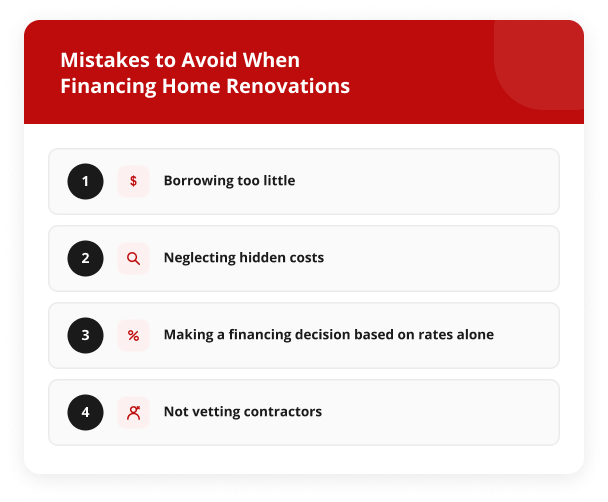
- Borrowing too little: Underestimating costs means you could run out of funds mid-project, forcing you to scramble for additional financing halfway through.
- Ignoring hidden costs: Permits, inspections, temporary housing, and unexpected repairs add up fast and can blow past your original budget.
- Choosing financing based only on rates: A low rate doesn’t always mean the best deal. Fees, closing costs, and repayment terms all factor into the true cost of borrowing. Additionally, it’s important to work with a reputable and supportive lender.
- Skipping contractor verification: Hiring an unlicensed or uninsured contractor to save money can lead to poor craftsmanship and liability issues down the road.
Finance Your Renovation Using the Right Strategy
Figuring out how to pay for home renovations comes down to matching your financial situation with the scope of work you’re planning. In order to successfully finance a home renovation project, compare your options, build a realistic budget, and work with a lender who can guide you through the process.
Griffin Funding offers a range of mortgage and home equity products designed to help homeowners finance renovations with confidence. Reach out to learn more about the best loan options to finance a home remodel 2026 or get started online with the lending process.
Frequently Asked Questions
How much does a home renovation cost?
It depends on the scope of work. A minor bathroom update might cost $5,000–$15,000, while a full kitchen remodel can run $30,000–$75,000 or more. Whole-home renovations can easily exceed $100,000. Always get multiple contractor estimates before committing to a budget.
Is financing a home renovation worth it?
In many cases, yes. Financing lets you complete improvements now rather than waiting years to save up. The cost of borrowing is often offset by the equity and enjoyment you gain, especially for high-ROI projects like kitchens and bathrooms.
What’s the best way to finance a renovation for a rental property?
Investment property owners often turn to home equity products or portfolio loans designed for rental properties. A DSCR HELOAN, for example, qualifies based on the property’s rental income rather than your personal income, which can be a practical option for investors who have irregular income or want to maintain cash-flow.
What is the 30% rule for home renovations?
The 30% rule is a rule of thumb suggesting you shouldn’t spend more than 30% of your home’s current market value on renovations. The idea is to avoid over-improving a property beyond what the neighborhood can support at resale. While not a strict rule, it’s a useful benchmark for setting a realistic renovation budget.
Find the best loan for you. Reach out today!
Get Started
Bill Lyons is the Founder, CEO & President of Griffin Funding. Founded in 2013, Griffin Funding is a national boutique mortgage lender focusing on delivering 5-star service to its clients. Mr. Lyons has 25 years of experience in the mortgage business. Lyons is seen as an industry leader and expert in real estate finance. Lyons has been featured in Forbes, Inc., Wall Street Journal, HousingWire, and more. As a member of the Mortgage Bankers Association, Lyons is able to keep up with important changes in the industry to deliver the most value to Griffin's clients. Under Lyons' leadership, Griffin Funding has made the Inc. 5000 fastest-growing companies list six times in its 13 years in business. Follow his updates on LinkedIn.
 Outstanding Client Experience
 Specialized Lending Solutions
 Direct-to-Consumer Advantage
 We're Advisors, NOT Salespeople
 Effortless Digital Mortgage Platform
Featured In



Recent Posts
Mortgage rates hit 18% in 1981. Here’s how that compares with buying a home today
Borrowers shopping for a 30-year fixed mortgage in the fall of 1981 saw rates peak at 18.63% in the week of Oc...

Average home equity gains topped $200,000 in six states as renters faced heavy housing costs
A rising home value can mean two very different things on the same street. For an established homeowner, it ca...
A 1-percentage-point mortgage rate rise can outrun 4 years of rent growth
The Federal Reserve raised interest rates on Sept. 16 for the first time since 2023. For rental property inves...