

What Is a Homestead Exemption?

 Written by Bill Lyons



Most homeowners pay more property taxes than they have to simply because they never filed a homestead exemption. It takes minutes to apply, can save you hundreds of dollars each year, and in some states it protects your home equity from creditors. Here is what you need to know.
- What Is a Homestead Tax Exemption?
- Who Qualifies for a Homestead Exemption?
- What Are the Benefits of a Homestead Exemption?
- How to Apply for Homestead Exemption
- Common Mistakes Homeowners Make When Filing
- Final Notes
- Frequently Asked Questions
Key Takeaways
- A homestead exemption reduces the taxable assessed value of your primary residence, which directly lowers your annual property tax bill.
- Eligibility generally requires that you own the home and occupy it as your primary residence, though additional rules may apply depending on the state and county you reside in.
- Some states extend the exemption to provide legal protection against creditors and forced sale of your home.
What Is a Homestead Tax Exemption?
A homestead exemption is a legal provision that reduces the taxable value of your primary residence, lowering the amount of property taxes you owe each year. It exclusively applies to the home you live in, not vacation homes or investment properties.
In addition to tax savings, several states also connect creditor protections to the homestead designation. In those states, a portion of your home equity is protected from unsecured creditors or forced sale during bankruptcy proceedings. The scope of that protection ranges from a few thousand dollars in some states to 100% of equity in others, such as Texas and Florida.
Because changes in tax policy at both the federal and state level can affect how homeowners calculate their overall housing costs, understanding every available benefit, including the homestead exemption, matters for long-term financial planning.
How Does a Homestead Exemption Work?
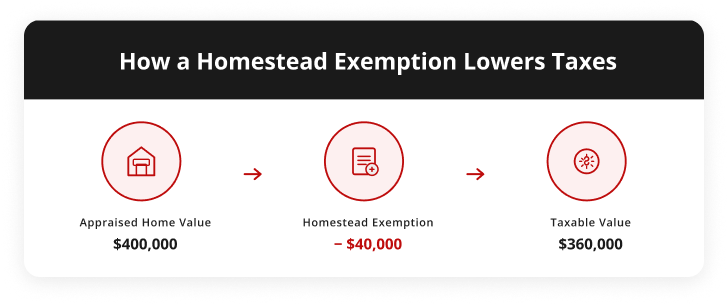
The homestead exemption works by subtracting a fixed dollar amount from your home’s assessed value before the tax rate is applied. For example:
- Home assessed value: $400,000
- Homestead exemption: $40,000
- Taxable value: $360,000
So, for instance, if your local tax rate is 1.2%, you would owe $4,320 instead of $4,800, saving almost $500 that year. How much you save also depends on where you live, since state property taxes vary widely across the country.
Why States Offer Homestead Exemptions
State legislatures created homestead exemptions for several reasons:
- Encourage homeownership: Tax relief makes owning a home more financially accessible.
- Protect vulnerable homeowners: Seniors, veterans, and disabled residents face fixed or reduced incomes, and lower tax bills reduce the risk of losing a home.
- Stabilize communities: Long-term residents staying in their homes supports neighborhood stability.
Who Qualifies for a Homestead Exemption?
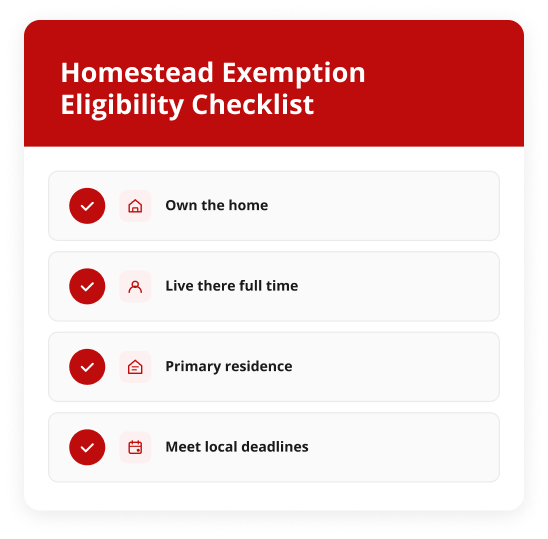
Most states share a common baseline of eligibility requirements:
- Own the home: The property must be in your name or co-owned with a spouse.
- Occupy it as your primary residence: In most states, the home is required to serve as your primary residence and you must live there full time to qualify.
- Meet state deadlines: Applications must be filed by a specific date, which varies depending on your state.
Additional Exemptions for Certain Groups
Many jurisdictions layer additional benefits on top of the standard exemption:
- Seniors: Older homeowners often qualify for enhanced exemptions or, in some states, a freeze on their home’s assessed value.
- Veterans: Disabled veterans may receive partial or full exemptions depending on their disability rating and state law.
- Disabled homeowners: Non-veteran homeowners with qualifying disabilities can access supplemental exemptions in many states.
- Surviving spouses: In some states, a surviving spouse may be eligible to continue the deceased veteran’s exemption under certain conditions.
What Are the Benefits of a Homestead Exemption?
The top benefits of a homestead exemption are as follows.
1. Lower Property Taxes
The primary benefit is a direct reduction in your annual property tax bill. In Texas, the standard exemption removes $140,000 from a home’s assessed value for school district taxes. In California, the Homeowners’ Exemption provides a $7,000 reduction in taxable value. The dollar savings depend on your local tax rate and the size of your exemption. Checking your home value helps you catch over-assessments before they inflate your bill.
The exemption applies only to primary residences, so rental and investment property owners need to look elsewhere for savings. There are still meaningful tax benefits for real estate investors available through other provisions.
Note: Exemption amounts, deadlines, and protections vary by county and are subject to change by state legislative session. Figures reflect statewide standard exemptions as of 2026; many counties offer additional local exemptions for seniors, veterans, and disabled homeowners. Georgia’s bankruptcy homestead exemption increases under HB 1024 effective July 1, 2026. Confirm current details with your county assessor or appraisal district before filing. This information is for general guidance and is not legal or tax advice.
2. Potential Bankruptcy or Creditor Protection
In states with strong homestead protections, the exemption also shields a portion of your equity from unsecured creditors. If you face a lawsuit or file for bankruptcy, creditors generally cannot force the sale of your home to satisfy a debt up to the protected amount. This protection does not apply to your mortgage lender, federal tax liens, or mechanics’ liens.
For homeowners considering states with strong asset protection as part of their financial strategy, it’s worth reading up on what makes certain states a tax haven before deciding where to put down roots.
3. Long-Term Homeownership Savings
The annual savings from a homestead exemption add up over time. A homeowner saving $600 per year over 20 years retains $12,000 that would otherwise go to taxes. In high-tax jurisdictions, the savings are even more substantial. Some states also cap how much a home’s assessed value can increase annually once the exemption is in place.
How to Apply for Homestead Exemption

Follow these steps to apply for a homestead exemption.
1. Gather Required Documents
Before filing, assemble the following documents:
-
- Driver’s license or state ID: Typically, your property’s address is required to be on your ID.
- Proof of residency: Utility bills, bank statements, and/or voter registration.
- Property deed or records: Confirms ownership of the property.
- Tax identification: Your parcel or account number from your property tax bill
2. File for Homestead Exemption With Your Local Tax Office
Submit your application through one of the following:
-
- County assessor’s office: Handles exemptions in most western states.
- Appraisal district: The relevant authority in Texas.
- Online portal: Most counties now offer electronic filing. Search for your county’s name plus “homestead exemption application.”
If you are navigating a purchase with non-QM loans or a traditional mortgage, your lender or title company may be able to point you toward local homestead exemption resources at closing.
3. Meet Filing Deadlines
Homestead tax exemption deadlines differ by state and sometimes by county. In Texas, the general deadline is April 30. In Florida, the deadline is March 1. Missing the deadline means waiting until the following tax year. Mark your calendar as soon as you take ownership of a home.
4. Verify Approval Status
After filing, confirm your exemption was applied by checking your county’s online property records or waiting for your updated property tax notice. If you do not see the exemption reflected, contact your county assessor directly.
Common Mistakes Homeowners Make When Filing
Take care to avoid these mistakes when filing for a homestead exemption.
- Missing the deadline: This one is the most common mistake. Once the filing window closes, you lose that year’s savings.
- Filing for the wrong property: The homestead exemption applies only to your primary residence. Filing on a rental or second home will result in denial and possibly penalties.
- Forgetting to renew: Some jurisdictions require annual renewal, while others make it permanent once filed. Take the time to confirm which rule applies in your county.
- Assuming approval is automatic: In most states, you must file an application. Buying a home and living in it does not automatically trigger the exemption.
Final Notes
A homestead exemption is one of the simplest and most overlooked benefits available to homeowners. The application process is usually straightforward, the savings are real, and in some states the legal protections provide you with meaningful financial security.
If you recently purchased a home, filing for a homestead exemption should be one of your first post-closing tasks. Shifts in tax policy at the federal and state level can also affect your overall housing costs, so staying informed on both fronts pays off over the long run.
Find the best loan for you. Reach out today!
Get StartedFrequently Asked Questions
Can you have more than one homestead exemption? 
Is a homestead exemption based on income?
How much money can I save with a homestead exemption?
In high-tax areas, savings can reach several hundred to over a thousand dollars per year. Texas homeowners, for example, can save over $1,000 annually in school district taxes alone under the current $140,000 exemption.
Do I need to renew my homestead exemption every year?

Bill Lyons is the Founder, CEO & President of Griffin Funding. Founded in 2013, Griffin Funding is a national boutique mortgage lender focusing on delivering 5-star service to its clients. Mr. Lyons has 25 years of experience in the mortgage business. Lyons is seen as an industry leader and expert in real estate finance. Lyons has been featured in Forbes, Inc., Wall Street Journal, HousingWire, and more. As a member of the Mortgage Bankers Association, Lyons is able to keep up with important changes in the industry to deliver the most value to Griffin's clients. Under Lyons' leadership, Griffin Funding has made the Inc. 5000 fastest-growing companies list six times in its 13 years in business. Follow his updates on LinkedIn.
 Outstanding Client Experience
 Specialized Lending Solutions
 Direct-to-Consumer Advantage
 We're Advisors, NOT Salespeople
 Effortless Digital Mortgage Platform
Featured In



Recent Posts
The rise of the five-house landlord: Wall Street blinked, small investors kept buying
In a single month, America’s biggest landlords cut their share of home purchases nearly in half. Firms t...

Mortgage rates hit 18% in 1981. Here’s how that compares with buying a home today
Borrowers shopping for a 30-year fixed mortgage in the fall of 1981 saw rates peak at 18.63% in the week of Oc...
Average home equity gains topped $200,000 in six states as renters faced heavy housing costs
A rising home value can mean two very different things on the same street. For an established homeowner, it ca...