

Top Secondary Cities for Real Estate Investors 2026

 Written by Bill Lyons



Major metros like New York, Los Angeles, and San Francisco still dominate the headlines, but savvy real estate investors in 2026 are looking elsewhere. Secondary cities across the US are offering lower entry prices, stronger rental yields, and genuine population momentum.
Whether you’re building a rental portfolio from scratch or expanding into new markets, understanding which secondary cities are positioned for long-term growth is one of the smartest moves you can make.
- What Is a Secondary City in Real Estate?
- Top Secondary Cities in the US for Real Estate Investors in 2026
- Why Secondary Cities Are Booming in 2026
- How to Evaluate Up and Coming Cities for Investment
- Risks of Investing in Secondary Cities
- Financing Investment Properties in Secondary Cities
- Explore the Best Up and Coming US Cities for Real Estate Investors
- Frequently Asked Questions
Key Takeaways
- Secondary cities in real estate are generally defined as mid-sized cities with established industries that demonstrate strong growth potential.
- Secondary cities offer lower acquisition costs, higher cap rates, and stronger population inflows than many primary markets in 2026.
- Remote work migration, affordability pressures in major metros, and economic diversification continue to drive demand in mid-sized US cities.
- Top secondary cities to watch include Chattanooga, Greenville, Boise, Bentonville, Huntsville, Colorado Springs, Knoxville, and Tampa.
What Is a Secondary City in Real Estate?
In real estate, markets are typically grouped into three tiers based on population size, economic activity, and investor activity:
- Primary cities: The largest, most liquid markets, like New York, Los Angeles, Chicago, and San Francisco. These markets offer stability but come with high entry costs.
- Secondary cities: Mid-sized metros, typically with populations between 250,000 and 2 million. They have diversified economies, growing infrastructure, and meaningful investor activity. Examples include Raleigh, Tampa, Indianapolis, Boise, and Columbus.
- Tertiary cities: Smaller markets, often dependent on a single employer or industry. They can offer high yields but carry more volatility and lower liquidity.
Why Investors Are Targeting Secondary Cities
- Lower entry prices: Median home prices in cities like Huntsville and Chattanooga run roughly 4% to 11% below the national average, and a fraction of San Francisco’s typical home value of about $1.15 million. In most secondary markets, your acquisition dollar simply goes further.
- Higher rental yields: Lower acquisition costs paired with strong rental demand translate into cap rates that are difficult to find in major metros.
- Population growth: Sun Belt and Mountain West secondaries have seen promising population growth for several years, driven by remote workers, young families, and retirees who are getting priced out of major cities.
- Business expansion and infrastructure investment: Corporate relocations, growing industries, and university expansions present economic opportunities and support population growth.
Key Metrics Investors Should Watch
Before committing to any secondary market, pull market insights for local housing data and track these fundamentals:
- Job growth: Year-over-year employment gains, especially in diversified sectors.
- Population migration: Net in-migration from Census and moving company data.
- Median home prices: Price-to-rent ratios and affordability trajectory.
- Rent growth: Annual rent increases relative to the national average.
- Vacancy rates: A residential vacancy rate below 5% generally indicates healthy rental demand.
- Cap rates: This can be a useful metric for rental properties, but make sure to consider it alongside local context.
Top Secondary Cities in the US for Real Estate Investors in 2026
Explore some of the top up and coming cities in the US for real estate investors.
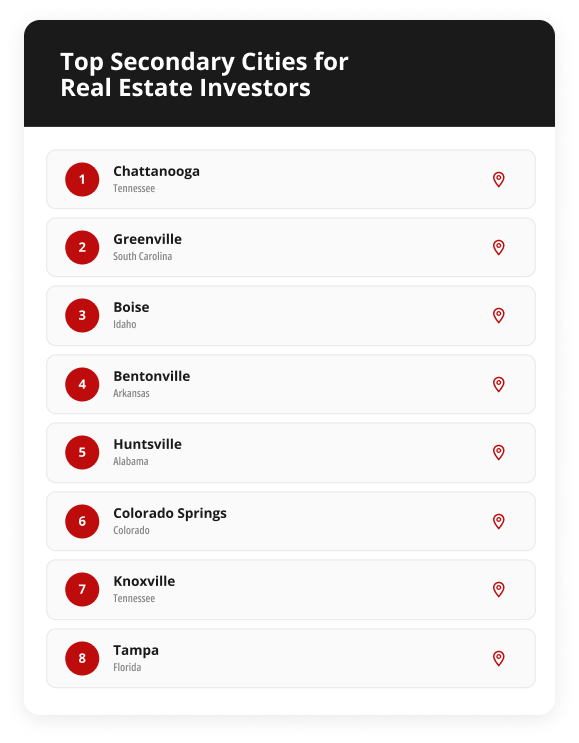
Sources: U.S. Census Bureau Population Estimates Program (Vintage 2025, July 1, 2025 releases via FRED); Zillow Home Value Index (ZHVI) data through May/June 2026; local economic development agencies and major employer reports. Populations rounded for readability. Home values are typical/ZHVI figures (metro or representative county/city level); actual median sale prices can vary by property type and neighborhood. Data as of mid-2026.
Chattanooga, Tennessee
Chattanooga, Tennessee has become one of the most compelling secondary markets in the Southeast. The city built its identity around becoming the first US city with community-wide gigabit internet, and that infrastructure investment has paid off with a growing tech and startup ecosystem.
Additionally, the city boasts a scenic outdoor lifestyle that’s drawing younger professionals looking for a lower cost of living without sacrificing quality of life.
Greenville, South Carolina
Greenville, South Carolina has undergone a remarkable transformation over the past decade, evolving from a manufacturing town into a vibrant mid-sized city with a thriving downtown, expanding healthcare sector, and a diversified economic base.
Major companies such as BMW, Michelin, and GE all have operations in the region, creating a reliable base of well-paid blue-collar and engineering workers.
Boise, Idaho
Boise, Idaho saw explosive growth during the pandemic years, but 2026 is presenting a more balanced opportunity. Rapid price appreciation has leveled out, inventory has loosened, and remote workers continue to arrive from California and the Pacific Northwest, attracted by outdoor recreation, lower taxes, and strong household incomes.
Bentonville, Arkansas
Bentonville, Arkansas is no longer just a Walmart company town — it’s becoming a legitimate secondary city with national investor attention.
Walmart’s ongoing corporate investment has attracted buy-in from suppliers, tech companies, and logistics operators, which has helped grow and diversify the city’s economy. The city has also made significant cultural investments, including world-class cycling trails and the Crystal Bridges Museum of American Art.
Huntsville, Alabama
Huntsville, Alabama is home to a massive aerospace, defense, and technology cluster anchored by NASA’s Marshall Space Flight Center, Redstone Arsenal, and other defense contractors. The result is a highly educated STEM workforce, strong household incomes, and low unemployment.
Colorado Springs, Colorado
Colorado Springs, Colorado benefits from proximity to Denver without Denver’s hefty home prices. The metro is home to multiple major military installations, including Fort Carson, the US Air Force Academy, and Peterson Space Force Base, which provide a permanent, stable base of renters. A growing tech sector is expanding industry in the region beyond the military foundation.
Knoxville, Tennessee
The University of Tennessee drives year-round rental demand for students and faculty. At the same time, the city serves as a gateway to the Great Smoky Mountains, generating strong short-term rental interest.
As Nashville has become increasingly expensive, Knoxville is attracting spillover investment and migration, given that the home prices in the latter region are much more affordable.
Tampa, Florida
Tampa, Florida deserves mention as the Sun Belt secondary market with perhaps the broadest base of demand drivers. Continuous domestic migration, a diverse economy spanning finance, healthcare, logistics, and tourism, and a relatively approachable price point compared to Miami have all combined to keep Tampa on nearly every investor’s shortlist. At a metro population north of 3 million, Tampa sits at the upper edge of the secondary tier, large enough for primary-market liquidity while still pricing well below coastal hubs.
Other Markets to Watch
The eight cities above lead the pack, but several other secondary markets show strong fundamentals worth tracking in 2026:
- Raleigh, North Carolina: The Research Triangle anchors one of the deepest tech and life-sciences job markets in the Southeast, drawing steady in-migration of young professionals and families.
- Columbus, Ohio: Ohio’s fastest-growing major metro is diversifying well beyond its government and university base, with Intel’s semiconductor investment reshaping the regional economy.
- Indianapolis, Indiana: A low cost of living, landlord-friendly laws, and a stable logistics and life-sciences economy make Indy a reliable cash-flow market for buy-and-hold investors.
- Kansas City, Missouri: An affordable price point, a growing tech and engineering sector, and central-US logistics access keep Kansas City on the radar for portfolio diversification.
- Madison, Wisconsin: The University of Wisconsin and a strong government and biotech base drive year-round rental demand and unusually low vacancy for a Midwest market.
Why Secondary Cities Are Booming in 2026
Secondary cities are booming in 2026 because three forces are converging: remote work has untethered demand from expensive coastal hubs, affordability pressure keeps pushing residents inland, and steady population migration is concentrating in the Sun Belt and Mountain West.
Remote and Hybrid Work Continue to Shape Housing Demand
The proliferation of remote-first companies and roles has impacted housing demand in regions across the country. Professionals who left San Francisco, New York, and Chicago in 2020–2022 largely stayed in their secondary city destinations. In 2026, a steady trickle of new remote workers continues to flow toward cities with lower costs, outdoor amenities, and a higher quality of life.
Affordability Challenges in Major Markets
Although real estate has seen steady appreciation for a long time, home prices surged from 2020-2022. This created major affordability challenges for would-be home buyers, especially in major cities. In places like New York, San Francisco, and Los Angeles, property prices shot out of reach for the average buyer.
In secondary cities, your money tends to go a lot further. In cities like Chattanooga, Greenville, and Huntsville, those looking to invest in real estate can begin building their portfolio without needing huge sums of capital upfront.
Population Migration Trends
Building a real estate portfolio across multiple secondary markets is one of the most effective ways to diversify geographic risk while maintaining strong yields.
- Sun Belt growth: Florida, Tennessee, Texas, and the Carolinas continue to receive net migration from expensive coastal states.
- Midwest resurgence: Columbus, Indianapolis, and Kansas City are drawing attention for their stability, affordability, and diversifying tech sectors.
- Tax-friendly states: States with no income tax or low property taxes are a consistent draw for both residents and investors.
How to Evaluate Up and Coming Cities for Investment
Take these steps into consideration before investing in a secondary city.
1. Look Beyond Home Prices
A cheap market isn’t automatically a good market. A city with declining population, weak job growth, high crime rates, and a deteriorating tax base probably won’t get you the return on investment you’re looking for. The best emerging markets are the ones where prices are still reasonable and the economic fundamentals look strong.
2. Analyze Employment and Industry Growth
Focus on metros adding jobs in multiple sectors. A city adding 5,000 defense jobs and 2,000 healthcare jobs is structurally stronger than one adding 7,000 jobs in a single company or industry.
3. Study Population and Migration Trends
Look at Census Bureau data and moving company reports to understand which cities are receiving net in-migration. Population growth is the single most important leading indicator for long-term real estate demand.
4. Evaluate Local Landlord Laws and Taxes
State-level landlord protections vary significantly. Tennessee, Arkansas, Idaho, South Carolina, and Florida are generally considered landlord-friendly environments. Research eviction timelines, rent control laws, and local property tax rates before committing to a market.
5. Understand Infrastructure Development
New highway interchanges, airport expansions, university campuses, and transit investments signal that a city’s government and private sector are investing in long-term growth. These projects create employment during construction and increase long-term property values in the region.
As you evaluate secondary cities to invest in, consider using free tools such as our home affordability calculator and rent estimator, which can help you better understand regional costs.
Risks of Investing in Secondary Cities
While secondary cities offer ample opportunities, investing in these regions also comes with risk.
Lower Liquidity Compared to Primary Markets
When you need to sell quickly, secondary markets have smaller buyer pools. This is manageable in normal conditions but can create problems in a downturn if you need to exit a position.
Potential Economic Dependence on One Industry
Some secondary cities that look diversified at a glance are actually dependent on a single large employer. Always research what would happen to the local economy if the largest employer shut down or moved elsewhere.
Market Volatility in Smaller Cities
Smaller markets can overshoot in both directions. The rapid appreciation in Boise from 2020–2022 was followed by a meaningful correction. Understanding where a market sits in its cycle matters.
Importance of Local Market Research
National data tells you the direction, while local data tells you the specifics. Work with local property managers, attend local real estate investor meetups, and verify rental comps at the street level before underwriting any deal.
Financing Investment Properties in Secondary Cities

Explore your financing options when it comes to investing in secondary cities. Not every loan product is designed for investment properties in secondary markets, but the right lender offers flexibility:
- DSCR loans: Debt service coverage ratio (DSCR) loans qualify borrowers based on the property’s rental income rather than personal income. This is the go-to product for investors scaling a portfolio in secondary markets. Use our free DSCR loan calculator to quickly get a snapshot of what this type of financing could look like.
- Conventional investment loans: Traditional financing for investors who meet standard income documentation requirements.
- Bank statement loans: Ideal for self-employed investors whose tax returns don’t fully reflect their income.
How Griffin Funding Helps Investors
Griffin Funding specializes in investment property loans and DSCR financing designed for investors targeting secondary markets. Our team can help you identify the type of real estate investment financing that best aligns with your needs and goals. Check where we lend to confirm availability in your target market.
For investors who want to track their portfolio, monitor cash flow, and manage their financial picture in one place, the Griffin Gold app provides a free tool built specifically for real estate investors.
Explore the Best Up and Coming US Cities for Real Estate Investors
By investing in up and coming cities in the US, you can start or grow your real estate portfolio at an affordable price point. The secondary cities on the above list have affordable entry prices, diversified economies, growing populations, and signs that point to continued rental demand.
Invest in the fastest growing cities in 2026 and stay a step ahead of the competition. Compare your options among DSCR lenders, understand the loan products available to you, and start building toward the portfolio you want. Contact Griffin Funding to discuss your financing options or get started online today.
Find the best loan for you. Reach out today!
Get StartedFrequently Asked Questions
Are up and coming cities better than major metros for real estate investors? 
Is financing a rental property in a secondary city easier compared to a major metro area?
DSCR loans are well-suited for secondary market investments because they qualify based on rental income rather than personal income, making it easier to scale a portfolio across multiple properties and markets.
What is a second-tier city?
Which secondary cities should investors avoid?
What is a good cap rate for a secondary-market rental?

Bill Lyons is the Founder, CEO & President of Griffin Funding. Founded in 2013, Griffin Funding is a national boutique mortgage lender focusing on delivering 5-star service to its clients. Mr. Lyons has 25 years of experience in the mortgage business. Lyons is seen as an industry leader and expert in real estate finance. Lyons has been featured in Forbes, Inc., Wall Street Journal, HousingWire, and more. As a member of the Mortgage Bankers Association, Lyons is able to keep up with important changes in the industry to deliver the most value to Griffin's clients. Under Lyons' leadership, Griffin Funding has made the Inc. 5000 fastest-growing companies list six times in its 13 years in business. Follow his updates on LinkedIn.
 Outstanding Client Experience
 Specialized Lending Solutions
 Direct-to-Consumer Advantage
 We're Advisors, NOT Salespeople
 Effortless Digital Mortgage Platform
Featured In



Recent Posts
The rise of the five-house landlord: Wall Street blinked, small investors kept buying
In a single month, America’s biggest landlords cut their share of home purchases nearly in half. Firms t...

Mortgage rates hit 18% in 1981. Here’s how that compares with buying a home today
Borrowers shopping for a 30-year fixed mortgage in the fall of 1981 saw rates peak at 18.63% in the week of Oc...
Average home equity gains topped $200,000 in six states as renters faced heavy housing costs
A rising home value can mean two very different things on the same street. For an established homeowner, it ca...