

One in ten U.S. mortgages now falls outside the Qualified Mortgage standard

 Written by Bill Lyons


Non-QM lending reached $239 billion in 2025, roughly 10% of all U.S. mortgage originations by dollar volume, according to a Griffin Funding analysis of Polygon Research’s loan-level HMDA data. A separate measure from Optimal Blue shows the trend continuing, with non-QM surpassing 10% of monthly rate-lock volume in July 2026.
That growth continued through a rule change meant to ease the problem behind it. In 2021, the CFPB removed Appendix Q, the rigid income-documentation appendix inside the Qualified Mortgage rule, after Congress twice proposed the same thing and never passed it. What replaced Appendix Q still routes self-employed income through tax returns, and borrowers kept leaving the QM box.
About 16.5 million Americans work for themselves, alongside real estate investors, 1099 workers, retirees and other borrowers whose income or assets may not fit neatly into traditional mortgage underwriting. More of them are now qualifying for mortgages through private-market documentation programs rather than through a federal standard, an expansion of access that came with different pricing than conventional financing.
The documentation gap
Conventional mortgage underwriting has a quirk that catches self-employed borrowers off guard. Lenders count what’s left after business deductions. That means many of the write-offs a CPA finds do double duty: They lower the tax bill, and they lower the income a lender is willing to recognize. A contractor whose business brings in $180,000 and who deducts aggressively might show a fraction of that on a return. On paper, that person can’t afford much house. In practice, the cash flow is there.
The pattern shows up in the research. An Urban Institute study found homeownership rates among the self-employed declined after the financial crisis even though self-employed households earn higher average incomes than salaried households, which points to documentation requirements rather than earning power as a barrier.
The mismatch traces back to how the rules were drawn. Traditional mortgage underwriting has generally been easier for borrowers with steady W-2 income than for people whose earnings come through business deposits, 1099s, or rental properties. When lawmakers introduced the Self-Employed Mortgage Access Act in 2018, the Qualified Mortgage rule relied on Appendix Q, a more prescriptive framework for documenting and calculating income.
The shape of the problem is specific rather than abstract. According to Griffin Funding’s own loan records, a Florida business owner who writes off most of his income on his tax returns was nonetheless able to document sufficient qualifying income through business bank deposits to complete a cash-out refinance on his primary residence. In Massachusetts, a self-employed professional whose earnings flowed through a regulated client-trust account qualified only after the deposits in that account were documented and explained as legitimate income, a structure no standard underwriting template anticipates. Neither borrower had a credit problem. Both had a paperwork problem. Both qualified through a bank statement loan, which derives income from 12 to 24 months of business deposits rather than tax returns.
The gap isn’t limited to business owners. Contractors and gig workers paid on a 1099 face a version of the same problem, and 1099 loans qualify them on those forms directly. Retirees and borrowers whose wealth sits in accounts rather than income streams run into it from the other direction, which is what asset-based lending addresses.
Griffin’s loan records show a similar pattern on the investor side. A Michigan medical practice owner purchased a rental property without documenting personal income by using a non-QM DSCR loan, which qualifies borrowers based on the property’s rental income rather than personal income and can allow the property to close in an LLC.
What Congress proposed, and what arrived instead
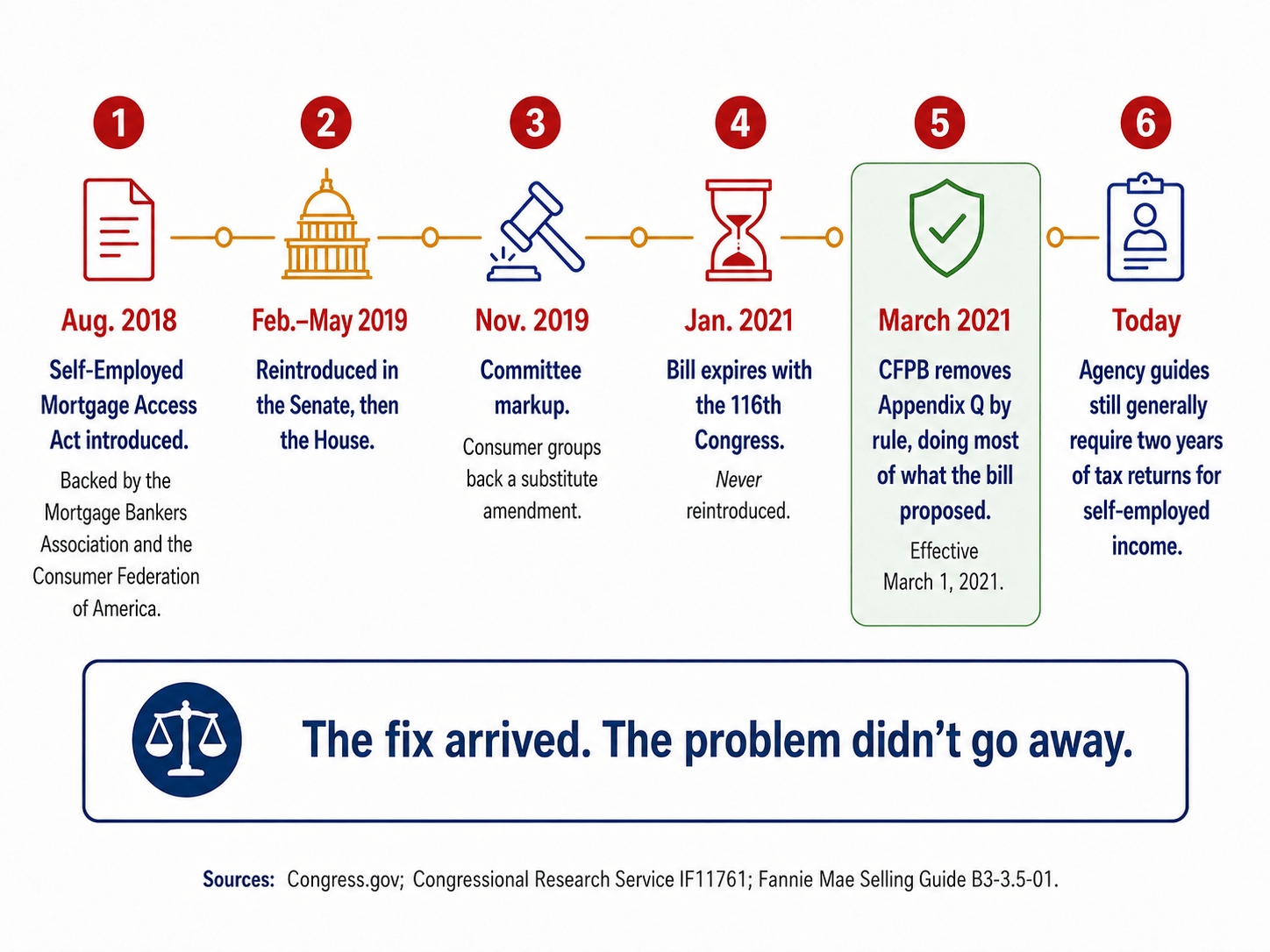 The change came twice, from two directions. Congress went first and didn’t finish. Regulators finished it, and the gap stayed open anyway.
In August 2018, Sens. Mark Warner (D-VA) and Mike Rounds (R-SD) introduced the Self-Employed Mortgage Access Act, aimed at a specific piece of the rulebook: Appendix Q, the income-documentation standard baked into the Qualified Mortgage rule. Rather than requiring Appendix Q alone, the bill would have let lenders satisfy the rule using underwriting standards already in place at FHA, the VA, USDA, Fannie Mae, and Freddie Mac. It drew support from both industry and consumer groups. At introduction, the Mortgage Bankers Association called it a way to give lenders and investors greater certainty, while Consumer Federation of America housing director Barry Zigas said it would give lenders and consumers an easier, less burdensome way to meet the tests without weakening their protections. The bill expired when that Congress ended.
It came back in February 2019, when Warner and Rounds reintroduced it in the Senate as S.540, joined by Sen. Cory Booker (D-NJ). Reps. Tom Emmer (R-MN) and Bill Foster (D-IL) followed in the House on May 1 with H.R.2445, and this time it got further. Foster offered a substitute amendment during House Financial Services Committee markup that November. The National Consumer Law Center and the Center for Responsible Lending both wrote in support of that substitute, an unusual alignment for a bill lenders also wanted.
The bill expired with the 116th Congress in January 2021. Two months later, on March 1, the CFPB’s General QM Final Rule took effect and did most of what the bill had proposed. It removed Appendix Q, replaced the 43% debt-to-income ceiling with a price-based test, and let lenders verify income using standards drawn from the guides of Fannie Mae, Freddie Mac, FHA, the VA, and USDA. That last provision is close to the bill’s own text.
What it didn’t change is how those guides treat a business owner. Fannie Mae generally requires a two-year history of self-employment income documented through tax returns, and still asks the lender to calculate qualifying income from what those returns report after deductions. The rulebook moved. The arithmetic didn’t.
As of August 2026, nothing has been reintroduced in Congress. A search of Congress.gov turns up no active bill, and Homebuyer.com’s Congressional Housing Bill Tracker, which follows 85 active housing and mortgage bills, lists no current version.
What the market built
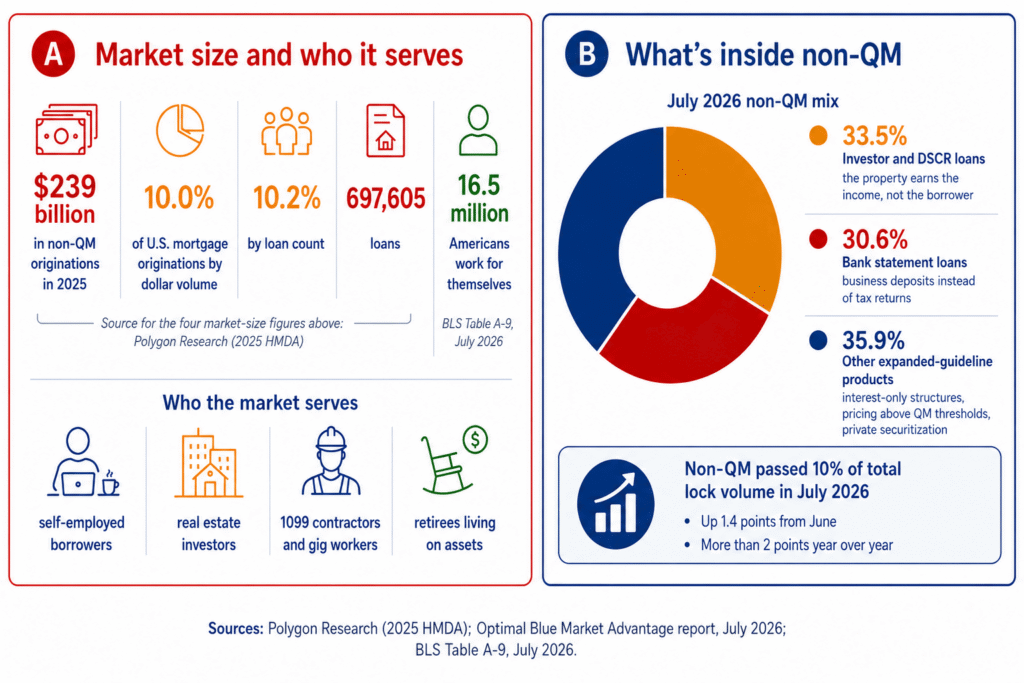 Non-QM lending kept growing. These are mortgages written outside the CFPB’s Qualified Mortgage standard, and the category is broader than documentation alone: it covers bank statement and DSCR underwriting, but also interest-only structures, loans priced above QM thresholds, and loans sold to private securitizers. In 2025 the whole category came to $239 billion across 697,605 loans, or 10% of U.S. originations by dollar volume.
Recent growth spans the entire category. Non-QM accounted for more than 10% of total lock volume in July 2026, the most recent month reported, up 1.4 percentage points from June and more than two points from a year earlier. Bank statement loans, the product built for the documentation gap, took 30.6% of that volume. Investor and DSCR loans, which qualify on a property’s rental income rather than the borrower’s and answer a different problem entirely, made up 33.5%. Other expanded-guideline products accounted for the remaining 35.9%.
The shift doesn’t appear to be a credit story. Across all July locks, conforming included, average credit scores held at 730 and debt-to-income ratios ran below year-earlier levels. Those are market-wide figures rather than non-QM-specific ones, but they show no broad deterioration in borrower quality alongside the product shift. What’s changed is that fewer transactions fit neatly inside the conforming box.
What changed, and what didn’t
So Appendix Q is gone, and one in ten mortgages is still written outside QM. Both things are true, and the second explains something about the first.
Look at how the volume splits and no single explanation holds. Investor and DSCR loans are 33.5%. Bank statement loans are 30.6%. Everything else is 35.9%. Three rough thirds, three different reasons a loan doesn’t fit. A business owner whose deductions shrink the income that an underwriter will count. An investor whose property earns the money, not the borrower. A retiree with assets and no paycheck. A borrower whose loan sits outside the standard for pricing or structure reasons that have nothing to do with income at all.
Pricing is the other factor. Non-QM still costs more than conventional financing, because lenders take on more risk without QM’s legal safe harbor and can’t sell the loans to Fannie or Freddie. Competition has compressed the spread as the market matured, but the gap remains. Borrowers using these programs are paying for a calculation that the QM framework still doesn’t offer.
The underlying mismatch remains. No QM pathway, before 2021 or after, qualifies a borrower on gross business deposits or on a property’s cash flow alone. Removing Appendix Q changed the rules. It didn’t change what the rules assume.
Notes on the data
The $239 billion figure comes from Polygon Research, which runs every HMDA loan record from 2018 through 2025 against the Ability-to-Repay and Qualified Mortgage standards in force that year and flags the ones falling outside. That yields 697,605 loans, 10% of originations by dollar volume and 10.2% by count. Most published non-QM estimates work from securitization data or lender names instead, which is why Polygon’s number runs higher.
Worth being clear about what that number is and isn’t. Non-QM is a regulatory category, not a borrower category. Loans land in it for interest-only structures, pricing above QM thresholds, or sale to a private securitizer, none of which say anything about how a borrower documents income. Polygon also includes business-purpose and DSCR loans in its broader non-QM classification. Read the $239 billion as Polygon’s broad measure of the non-QM market captured in HMDA, not as a count of self-employed borrowers.
Monthly figures come from Optimal Blue’s July 2026 Market Advantage report, built on the pricing engine used to lock more than a third of U.S. mortgages, as covered by National Mortgage Professional. Optimal Blue separately tracks a broader non-conforming category that folds in jumbo loans and reached 20.8% in July. That isn’t a non-QM number and isn’t used here. Self-employment counts are from BLS Table A-9 for July 2026: 6.645 million incorporated and 9.844 million unincorporated, which BLS publishes separately. Legislative history came from Congress.gov, sponsors’ releases, and the House Financial Services Committee memo accompanying the November 2019 markup, with current status checked against Congress.gov and the Homebuyer tracker.
Borrower examples come from Griffin Funding’s 2026 funded-loan records, described without names, loan identifiers, or amounts. They illustrate documentation patterns rather than typical results. This is a market-level and legislative analysis.
Find the best loan for you. Reach out today!
Get Started
Bill Lyons is the Founder, CEO & President of Griffin Funding. Founded in 2013, Griffin Funding is a national boutique mortgage lender focusing on delivering 5-star service to its clients. Mr. Lyons has 25 years of experience in the mortgage business. Lyons is seen as an industry leader and expert in real estate finance. Lyons has been featured in Forbes, Inc., Wall Street Journal, HousingWire, and more. As a member of the Mortgage Bankers Association, Lyons is able to keep up with important changes in the industry to deliver the most value to Griffin's clients. Under Lyons' leadership, Griffin Funding has made the Inc. 5000 fastest-growing companies list six times in its 13 years in business. Follow his updates on LinkedIn.
 Outstanding Client Experience
 Specialized Lending Solutions
 Direct-to-Consumer Advantage
 We're Advisors, NOT Salespeople
 Effortless Digital Mortgage Platform
Featured In



Recent Posts
The rise of the five-house landlord: Wall Street blinked, small investors kept buying
In a single month, America’s biggest landlords cut their share of home purchases nearly in half. Firms t...

Mortgage rates hit 18% in 1981. Here’s how that compares with buying a home today
Borrowers shopping for a 30-year fixed mortgage in the fall of 1981 saw rates peak at 18.63% in the week of Oc...
Average home equity gains topped $200,000 in six states as renters faced heavy housing costs
A rising home value can mean two very different things on the same street. For an established homeowner, it ca...