

Home equity reaches a record $18 trillion among US mortgage holders. Here is where it runs deepest
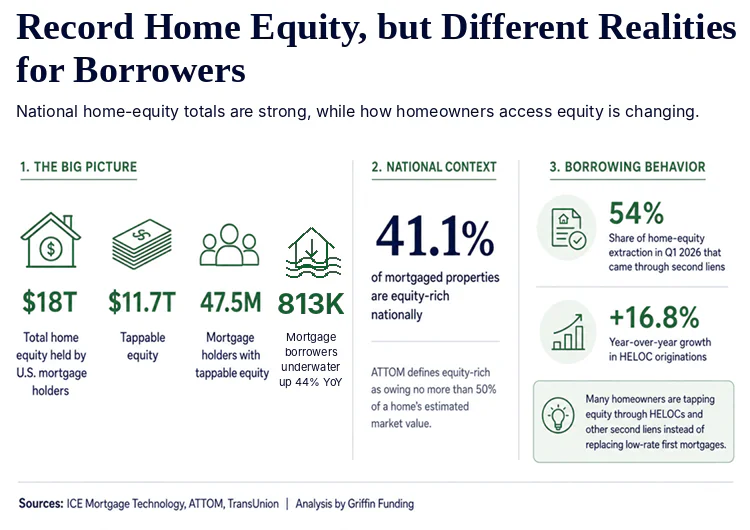
For millions of Americans, the home they already own has become one of their strongest financial assets. U.S. mortgage holders collectively held a record $18 trillion in home equity in the second quarter of 2026, according to ICE Mortgage Technology’s August 2026 Mortgage Monitor. Within that total, ICE classified $11.7 trillion as tappable equity, held by 47.5 million mortgage holders.

 Written by Bill Lyons



That does not mean every borrower can access their full share of that total or would qualify to borrow against it. ICE also counted roughly 813,000 borrowers who owe more than their homes are worth, a 44% increase from a year earlier, concentrated among FHA and VA borrowers and people who bought between 2022 and 2025. Both figures describe the same market: housing wealth at a record high, and a small but growing group of recent buyers with no equity to draw on.
To see where that cushion is deepest, Griffin Funding reviewed ATTOM’s Q2 2026 U.S. Home Equity & Underwater Report and its state-by-state equity ranking. The result is a striking divide: In Vermont, nearly four out of five mortgaged properties are equity-rich. In Louisiana, fewer than one in five meet the same standard.
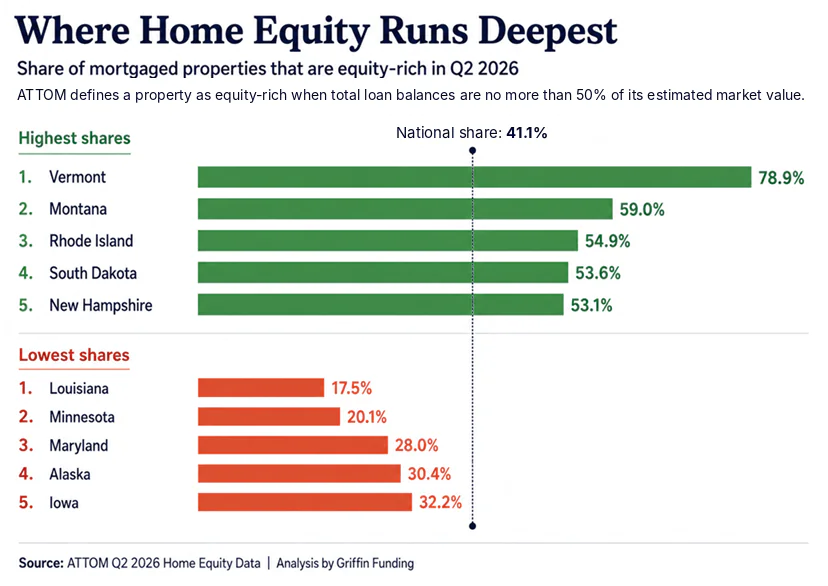
ATTOM defines a mortgaged property as equity-rich when the combined estimated balance of loans secured by the home is no more than half of its estimated market value. Nationally, 41.1% of mortgaged residential properties met that definition in Q2 2026.
Where home equity runs deepest
Vermont led the country by a wide margin, with 78.9% of mortgaged properties classified as equity-rich. Montana ranked second at 59.0%, followed by Rhode Island at 54.9%, South Dakota at 53.6% and New Hampshire at 53.1%.
The Northeast is especially well represented. Seven of the 10 highest-ranking states are in the region, and Vermont sits nearly 38 percentage points above the national rate.
At the other end of the ranking, Louisiana had the smallest equity-rich share at 17.5%. Minnesota followed at 20.1%, then Maryland at 28.0%, Alaska at 30.4% and Iowa at 32.2%.
The distance between those markets is a reminder that a record national total does not describe every mortgage holder’s experience.
The national cushion is strong, but not evenly distributed
The record $18 trillion total is a strong national backdrop. But ATTOM’s Q2 report contains an important countertrend: The share of mortgaged properties considered equity-rich fell from 47.4% in Q2 2025 to 41.1% one year later.
After four consecutive quarterly declines, the rate is near a five-year low. ATTOM also updated the report to exclude transactions in which a single jumbo loan is secured by multiple properties. The company did not quantify the effect of that change, so year-over-year comparisons should be interpreted cautiously.
Only four states posted year-over-year increases: North Dakota, South Dakota, Kentucky and Wyoming. Every other state in ATTOM’s state-level ranking had a smaller equity-rich share than a year earlier.
Minnesota experienced the sharpest decline, falling from 37.6% to 20.1%. It also had the highest seriously underwater rate in the country at 12.1%, up from 2.6% a year earlier, per ATTOM’s Q2 report. and Minneapolis had the highest seriously underwater rate among large metros ATTOM analyzed, with the second-lowest equity-rich share behind Baton Rouge. Michigan dropped from 50.8% to 39.3%, while California declined from 56.9% to 45.6%.
The pattern also appeared across large metros: 104 of the 108 areas ATTOM analyzed had lower equity-rich shares than a year earlier. The bottom of the distribution moved as well. ATTOM counted 3.2% of mortgaged properties as seriously underwater, meaning loan balances at least 25% above estimated market value, up from 2.7% a year earlier.
At first, that may seem to conflict with ICE’s record equity figure. It does not. ICE estimates the total dollar value of equity held by mortgage borrowers. ATTOM measures the percentage of mortgaged properties that clear a much higher bar: having at least 50% equity.
The country can therefore hold more equity in total, while a smaller share of properties meets ATTOM’s equity-rich threshold. A homeowner can also have meaningful equity without owning half of the property outright.
Low-rate mortgages are changing how owners access equity
Home equity is not cash sitting in an account. To use it, a homeowner generally has to sell the property or borrow against it.
For many owners, the second option now comes with a difficult calculation. They may have substantial equity, but they may also have a first mortgage secured when rates were considerably lower.
A cash-out refinance replaces that existing mortgage with a new, larger first mortgage. For someone who already has a favorable rate, refinancing the full balance may be an expensive way to access only part of the home’s equity.
That helps explain renewed interest in HELOCs and other home equity financing options. A HELOC, home equity loan or other second lien may allow a qualified homeowner to borrow against the property while leaving the original first mortgage in place.
In the first quarter of 2026, 54% of all home-equity extraction came through second liens, according to ICE’s June Mortgage Monitor. Second-lien withdrawals reached their strongest first-quarter volume in 18 years as more borrowers sought to preserve existing low-rate mortgages.
TransUnion’s Q2 2026 Credit Industry Insights Report showed a similar shift. Home-equity originations rose 5.8% year over year to 560,000 in the first quarter of 2026, driven by a 16.8% increase in HELOC originations. TransUnion reports origination data one quarter in arrears.
Borrowing against a home is not free money. It adds debt, creates another payment and uses the property as collateral. But for qualified homeowners who understand those tradeoffs, accumulated equity can create choices that would not otherwise exist.
 The same equity can serve very different homeowners
A longtime homeowner may view equity as a safety net that can remain untouched for years. Another might use part of it for renovations, debt consolidation or a large, planned expense.
For a self-employed homeowner, the challenge may be less about whether wealth exists and more about how income is documented. Business owners, freelancers and entrepreneurs often have earnings that do not arrive as a steady paycheck. In those cases, bank statement loans may evaluate qualifying income using deposits rather than relying solely on W-2s, pay stubs or traditional tax-return calculations.
Real estate investors may look at equity differently. Equity built in an existing rental property can become part of a decision to renovate, refinance or pursue another acquisition. When financing rental properties, debt service coverage ratio (DSCR) loans primarily evaluate the property’s rental income rather than the investor’s traditional employment income.
These borrowers may have different goals, but the underlying benefit is the same: financial flexibility.
For many mortgage holders, the real value is having options
The record $18 trillion figure is a sign of strength, but it should not be read as an invitation for every homeowner to take on more debt.
Some owners may choose to borrow against their equity. Others may leave it untouched, allowing it to remain part of their long-term household wealth.
What matters is that millions of mortgage holders now have a meaningful cushion inside the homes they already own.
That cushion is deeper in Vermont than in Louisiana, while many recent buyers have far less equity to draw on. But across the country, home equity remains one of the most important sources of household financial resilience.
For many mortgage holders, its greatest value may be simple: It gives them options.
Methodology
Griffin Funding reviewed ATTOM’s Q2 2026 state-level home equity data to identify where mortgaged properties had the highest and lowest equity-rich shares. The review also compared Q2 2026 figures with Q2 2025 percentages for each state in ATTOM’s published ranking.
ATTOM classifies a mortgaged residential property as equity-rich when the estimated combined balance of loans secured by the property is no more than 50% of its estimated market value. State percentages describe mortgaged properties, not individual people or homes owned free and clear.
ATTOM notes in its Q2 2026 report that it updated the analysis to exclude activity in which a single jumbo loan is secured by multiple properties, which previously offset loan-to-value ratios in markets with heavier investor participation. Year-over-year comparisons in this analysis should be read with that revision in mind. Negative equity figures come from ICE’s August 2026 Mortgage Monitor. TransUnion reports origination volumes one quarter in arrears, so figures cited from its Q2 2026 report describe first-quarter originations.
National total and tappable-equity estimates come from ICE Mortgage Technology. Home-equity origination and second-lien trends are based on data from ICE’s June Mortgage Monitor and TransUnion’s Q2 2026 Credit Industry Insights Report.
Find the best loan for you. Reach out today!
Get Started
Bill Lyons is the Founder, CEO & President of Griffin Funding. Founded in 2013, Griffin Funding is a national boutique mortgage lender focusing on delivering 5-star service to its clients. Mr. Lyons has 25 years of experience in the mortgage business. Lyons is seen as an industry leader and expert in real estate finance. Lyons has been featured in Forbes, Inc., Wall Street Journal, HousingWire, and more. As a member of the Mortgage Bankers Association, Lyons is able to keep up with important changes in the industry to deliver the most value to Griffin's clients. Under Lyons' leadership, Griffin Funding has made the Inc. 5000 fastest-growing companies list six times in its 13 years in business. Follow his updates on LinkedIn.
 Outstanding Client Experience
 Specialized Lending Solutions
 Direct-to-Consumer Advantage
 We're Advisors, NOT Salespeople
 Effortless Digital Mortgage Platform
Featured In



Recent Posts
The rise of the five-house landlord: Wall Street blinked, small investors kept buying
In a single month, America’s biggest landlords cut their share of home purchases nearly in half. Firms t...

Mortgage rates hit 18% in 1981. Here’s how that compares with buying a home today
Borrowers shopping for a 30-year fixed mortgage in the fall of 1981 saw rates peak at 18.63% in the week of Oc...
Average home equity gains topped $200,000 in six states as renters faced heavy housing costs
A rising home value can mean two very different things on the same street. For an established homeowner, it ca...