

Scaling multi-unit real estate: Conforming loan limits vs. cash-flow financing
Real estate investors who want to scale multi-unit real estate portfolios face two issues. Tax optimization strategies and income constraints cause them to hit a wall when they reach 3-5 properties if they don’t understand how DSCR loans and cash-flow underwriting work. However, as Griffin Funding, a mortgage and home loan lender, explains below, asset-based financing based on a property’s gross rental income can continue to scale.

 Written by Bill Lyons



The Federal Housing Finance Agency (FHFA) announced last year that conforming loan limit values (CLLs) would rise in 2026, with the baseline for one-unit properties up by $26,250 to a new high of $832,750. At the same time, the two-unit limit crept up to $1,066,250, while four-unit properties increased to $1,601,750.
Bear in mind that these figures are dependent on median house prices in a given area, meaning that some regions have even higher CCLs. For instance, in Los Angeles County, the two-unit limit now sits at $1,599,375.
The Reality of Two to Four Unit Conforming Loan Limits
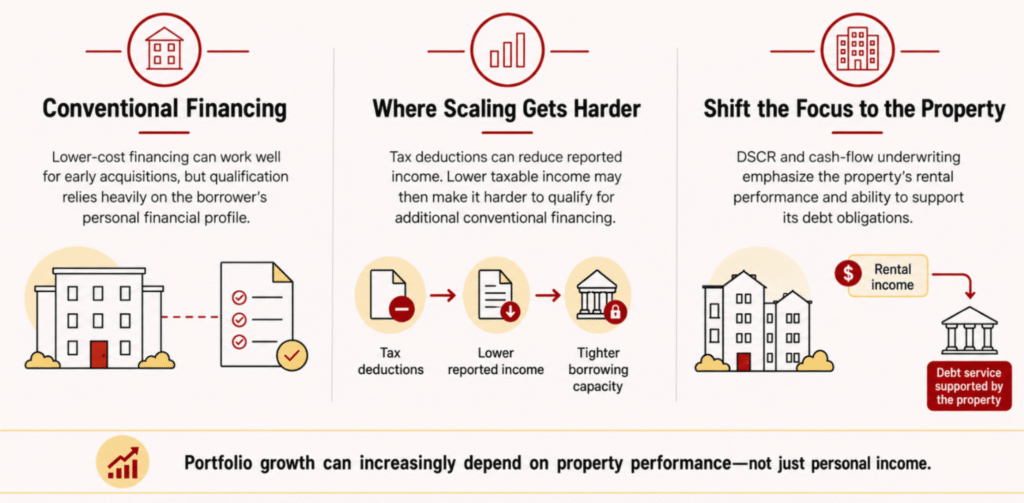
Conventional financing through Fannie Mae and Freddie Mac relies heavily on strict baseline thresholds that set caps based on property size. As mentioned, the standard caps allow up to $1,066,250 for two-unit properties and $1,601,750 for four-unit properties across standard cost areas. High-cost markets offer elevated ceilings, but accessing those funds takes even more time and involves additional bureaucracy.
Even when falling below the CLL threshold, agency guidelines impose severe restrictions on the borrower behind the loan. Traditional lenders evaluate personal W-2 income, demand two years of full tax returns, and hold borrowers to a debt-to-income (DTI) ceiling that tops out between 45% and 50% depending on how the loan is underwritten. The long-standing rule of thumb is tighter still: the 28/36 rule puts housing costs at 28% of gross monthly income and total debt at 36%.
The central problem with this traditional model is how banks calculate rental income. Most conventional underwriters cut projected lease revenues by 25% for vacancy buffers, then offset that against existing personal debts.
When writing off legal tax deductions to optimize annual real estate cash flow, tax returns will show artificially lowered net income. This accounting practice works great for reducing tax obligations, but it inadvertently destroys personal DTI calculations for future conventional acquisitions.
Cash-Flow Underwriting as a Means of Shifting Focus to Property NOI
Debt service coverage ratio (DSCR) financing completely reframes how lenders evaluate investment risk by shifting focus away from personal paychecks. Instead of analyzing W-2s, cash-flow underwriting evaluates whether the asset generates enough gross rental income to cover its own monthly principal, interest, taxes, and insurance (PITI).
When scaling a multi-family portfolio, real estate investors can utilize cash-flow-based DSCR loans to qualify based on property rental revenue rather than personal debt-to-income ratios. This fundamental shift removes the personal income ceiling entirely. A DSCR loan allows multi-unit investors to qualify based purely on the building’s gross rental income, skipping personal DTI limits and tax returns entirely.
DSCR is calculated by dividing gross rental income by the cost of servicing the debt, which in this case is made up of PITI. So, for example, a property generating $10,000 per month in lease revenue against a monthly total mortgage payment of $8,000, yields a DSCR of 1.25. Lenders generally look for a ratio of at least 1.0 to approve financing without demanding personal income documentation, with the strongest pricing reserved for ratios at 1.25 and above.
Comparing Financing Structures
Choosing the right debt structure depends on whether borrowers prioritize raw leverage or rapid portfolio expansion. Investors evaluating multi-unit options generally consider three main trade-offs. Agency loans offer lower interest rates but enforce strict personal DTI limits and maximum property counts. DSCR financing skips tax return verifications entirely by focusing strictly on property lease performance, and cash-flow loans streamline closing timelines because underwriters analyze real estate appraisals rather than personal tax histories.
Because DSCR loans evaluate the real estate entity itself rather than a borrower’s personal paycheck, properties can be acquired directly inside an LLC or asset protection trust from day one. This avoids the deed transfer headaches and due-on-sale triggers common with conventional agency financing.
Expanding Strategically
Relying exclusively on conventional agency loans can eventually force real estate investors to hit a wall created by paper income limits. While conforming financing offers competitive long-term interest rates for initial acquisitions, scaling a sustainable two to four-unit portfolio often requires shifting to asset-based debt solutions. Leveraging cash-flow underwriting means active real estate investors can continue acquiring cash-flowing multi-unit assets based on the financial merits of the buildings themselves, maintaining steady momentum regardless of tax return adjustments.
Find the best loan for you. Reach out today!
Get Started
Bill Lyons is the Founder, CEO & President of Griffin Funding. Founded in 2013, Griffin Funding is a national boutique mortgage lender focusing on delivering 5-star service to its clients. Mr. Lyons has 25 years of experience in the mortgage business. Lyons is seen as an industry leader and expert in real estate finance. Lyons has been featured in Forbes, Inc., Wall Street Journal, HousingWire, and more. As a member of the Mortgage Bankers Association, Lyons is able to keep up with important changes in the industry to deliver the most value to Griffin's clients. Under Lyons' leadership, Griffin Funding has made the Inc. 5000 fastest-growing companies list six times in its 13 years in business. Follow his updates on LinkedIn.
 Outstanding Client Experience
 Specialized Lending Solutions
 Direct-to-Consumer Advantage
 We're Advisors, NOT Salespeople
 Effortless Digital Mortgage Platform
Featured In



Recent Posts
Mortgage rates hit 18% in 1981. Here’s how that compares with buying a home today
Borrowers shopping for a 30-year fixed mortgage in the fall of 1981 saw rates peak at 18.63% in the week of Oc...

Average home equity gains topped $200,000 in six states as renters faced heavy housing costs
A rising home value can mean two very different things on the same street. For an established homeowner, it ca...
A 1-percentage-point mortgage rate rise can outrun 4 years of rent growth
The Federal Reserve raised interest rates on Sept. 16 for the first time since 2023. For rental property inves...