

Can You Get a Mortgage Without a Job?

 Written by Bill Lyons


KEY TAKEAWAYS
- Getting a mortgage without a job is possible, but you must still demonstrate your ability to repay the loan by providing the lender with proof of income.
- Securing a home loan without a job typically involves higher interest rates because the lender takes on more risk.
- There are several ways you can improve your chances of getting a mortgage without a job, including getting a co-signer, leveraging your assets, and tapping into cash reserves.
It’s possible to get a mortgage without a job, but you will still have to provide proof of income in some way and may need to utilize alternative financing products. However, options exist for getting a mortgage without a traditional job, whether you’re a freelancer, small business owner, or simply between jobs. Explore the different ways that you can get a home loan without a job.
Can You Get a Home Loan Without a Job?

Yes, unemployed individuals or those without full-time jobs may still be eligible for a mortgage loan. However, qualifying for home loans is much more challenging if you don’t have a consistent source of income from a job. This is because lenders usually use pay stubs, W–2s, and tax returns to evaluate a borrower’s income.
Many people have jobs, but they’re self-employed or gig workers that don’t have typical W-2 jobs lenders look for when approving applications for traditional loans. Additionally, retirees are no longer working, but they still have a reliable source of income. Regardless of where your income comes from, as long as you can prove your ability to repay the loan, you can still qualify for a mortgage.
Lenders prefer that borrowers have a reliable stream of income, but that doesn’t necessarily mean you need to have a full-time job or work for an employer. Instead, you can use alternative sources of income, such as:
- Small business or freelance income
- Investment income
- Profit and loss (P&L) statements
- Bank statements
- Proof of liquid assets
- Rental income
- Social Security income
- Pension benefits
Additionally, some lenders will take into account supplemental income sources such as child support and alimony payments.
Risks of Getting a Mortgage With No Job
Unfortunately, there are downsides to getting a mortgage without a job. Since you might be viewed as a higher-risk borrower because you don’t have a full-time job, lenders can pass some of their risk onto you.
Mortgage loans for individuals without jobs typically have higher interest rates because they’re riskier investments for the lender. Additionally, they may come with lower loan amounts and stricter approval requirements to ensure a borrower can repay the loan. In most cases, lenders will require a larger down payment regardless of the type of loan.
How to Get a Mortgage Without a Job
Unfortunately, strict underwriting processes prevent many qualified borrowers from getting approved for a loan because they don’t have typical income. Here are a few ways to improve your chances of getting a mortgage without a job:

1. Get a Co-Signer
One of the easiest ways to get a mortgage without a job is to use a co-signer who is a parent or spouse. These individuals should be employed or have a high net worth to prove their ability to repay the mortgage loan if, for some reason, the primary borrower can’t.
A co-signer reduces risk for the lender because they’ll be responsible for paying the loan. Additionally, finding a co-signer with a full-time job, a high credit score, and large savings can increase your loan amount because it adds security for the lender.
It’s important to note that a co-signer is different from a co-borrower. A co-borrower has more responsibility and becomes an owner with you because their name is on the loan, so they’re expected to make payments. Co-borrowers are usually couples, spouses, or friends who decide to purchase a home together. Having a co-borrower can drastically improve your chances of getting approved for a mortgage if you’re unemployed.
Choosing between a co-borrower and co-signer depends on the nature of your relationship and how involved the second person wants to be. For example, if you plan on living together and are both responsible for paying the mortgage, you can be co-borrowers. However, if the person doesn’t plan on living in the home, they’ll be a co-signer.
2. Leverage Alternative Income
Working a 9-5 job isn’t the only way people earn an income. Any money you make is considered income, whether it’s from investments or alimony payments. Lenders consider all of your income to determine your eligibility for a home loan.
However, it’s important to note that mortgage lenders prefer that you have some type of job, whether you’re self-employed, a freelancer, or a part-time employee, to ensure that you’ll continue to have a reliable income for the life of your loan.
That said, lenders will take into consideration income from other sources, such as:
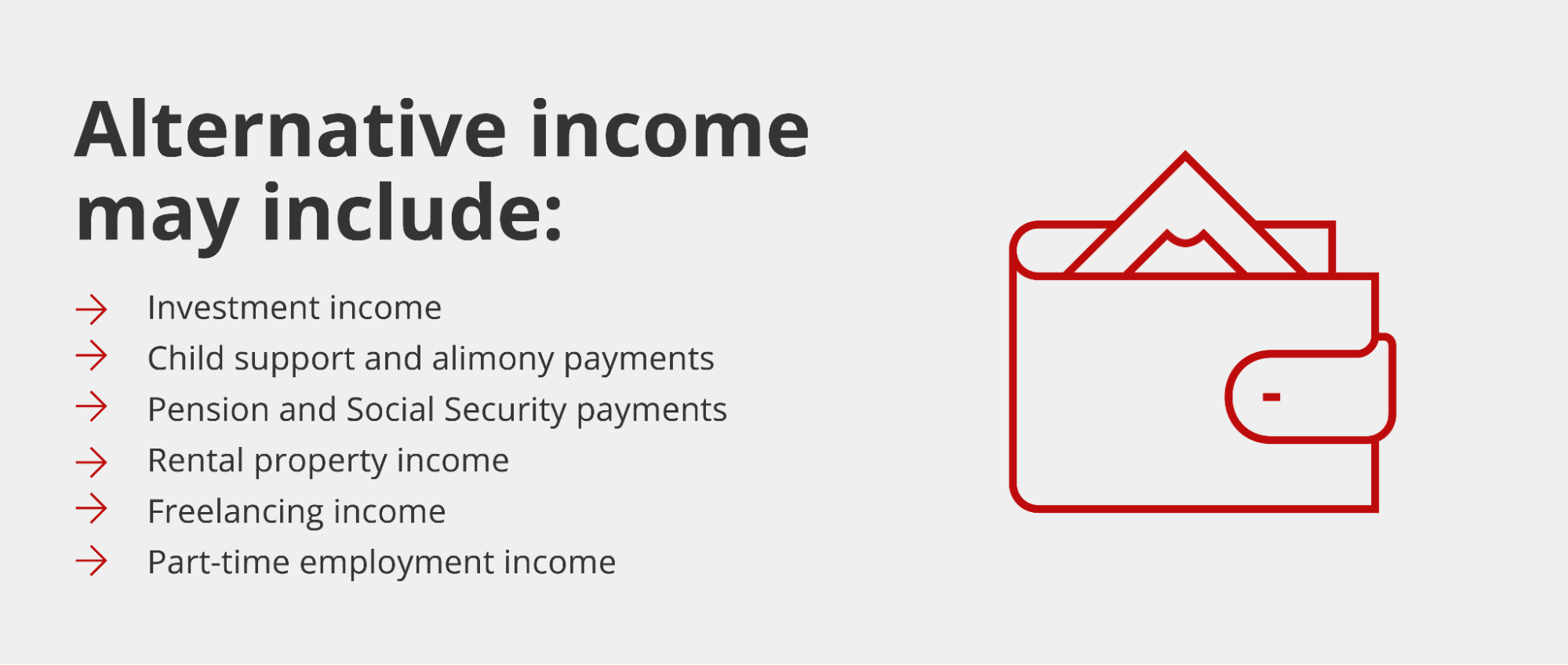
- Investment income from stocks, bonds, money market accounts, etc.
- Child support and alimony payments
- Pension payments
- Social Security payments
- Rental property revenue
- Freelancing income
- Part-time employment income
In any case, it’s crucial that you can provide documentation for your income so your lender can verify it.
3. Tap Into Cash Reserves
Some people don’t work because they don’t have to. For example, you can get a loan as a retiree because you still earn enough income from your retirement and your investments to purchase a home, while others have high net worth and don’t have to get a full-time job. Whatever the case, you can tap into your cash reserves to secure financing for a home.
Lenders prefer that you have a consistent and reliable income, but lack of employment or a regular employment status doesn’t mean that you can’t afford your mortgage. Instead, you may have significant assets that allow you to get a mortgage with no job but a large deposit.
You can get a mortgage with no job but a large deposit if it makes financial sense for you. If you have a good credit history, lenders may be willing to look past your unemployment if you have cash reserves that will help you pay for the loan.
A larger down payment can reduce your interest rate and gives you a small loan balance, making your monthly payments more manageable. In addition, lenders may be more willing to approve your loan if you have enough savings to pay your mortgage for at least a few months.

Showing your lender that you can put down a higher down payment and pay for the mortgage through your savings is best for individuals who are either between jobs, waiting to start a new job, or self-employed because it means that you’re either working or will soon be working. However, retirees can also use cash reserves to demonstrate their ability to repay the loan by showing investment and retirement account balances.
4. Use Assets as Income
Using your assets is another way to get approved for a home loan when you don’t have a job. Lenders will review your assets to determine whether you can liquidate them when necessary to pay your monthly mortgage premium. However, many lenders have rules for the types of assets they’ll accept.
The following assets are examples of what you may be able to use as income to qualify for a home loan without a job:
- Stocks and bonds
- Certificates of deposit (CDs)
- Checking and savings accounts
- Retirement accounts
When you obtain a home loan, the property itself serves as collateral. However, with some loan types, such as asset-based loans, lenders use your assets as income to determine whether you qualify for the loan. For home loans, your assets show your cash flow, and lenders prefer to use only liquid assets that you can readily use to pay your monthly mortgage bills.
Download the Griffin Gold app today!
Take charge of your financial wellness and achieve your homeownership goals
Use invitation code: GRIFGOLD to register.


Loan Types for Buying a House Without a Job
There are several types of non-qualified mortgages that offer greater flexibility than traditional loans, which can benefit those without a job or regular income. Some types of no income mortgage loans you can get without a job include the following:

Asset-Based Loan
An asset-based mortgage, also called an asset-depletion mortgage, uses your assets as income rather than collateral. The more valuable your assets, the more money you can borrow. This type of lending is ideal for high-net-worth individuals, retirees, and small business owners who don’t have a traditional source of income but have enough in assets to pay their mortgage bills.
Asset-based lending has more flexible requirements and a more streamlined application process because the lender doesn’t have to confirm your employment history or income. Instead, they verify the value of your assets. The types of assets you can use for this type of loan include:

- Bank accounts
- Certificates of deposit (CDs)
- Investment accounts
- Retirement accounts
- Money market accounts
One thing all of these assets have in common is that they’re liquid. Borrowers can easily take money out to pay their mortgages. Although it is a possibility, most lenders won’t allow you to use non-liquid (illiquid) assets that have to be sold to generate cash, such as vehicles, art, collectibles, and real estate.
Bank Statement Loan
Bank statement loans are similar to asset-based loans. However, instead of using all of your assets to qualify for the loan, you’ll demonstrate your ability to repay using bank statements. With this type of loan, you do need to be earning a regular income, but you don’t have to have a typical job or be an employee.
Instead, you can be a self-employed individual, freelancer, gig worker, or small business owner who can prove a reliable source of income through tax returns. These types of loans are best suited for individuals that don’t get a W-2 or pay stubs from an employer or claim significant write-offs on their tax returns.
Depending on your lender, you’ll be required to provide a certain number of bank statements — usually 12 to 24 months’ worth — to prove that you have a reliable source of income and the ability to repay the loan. Use our bank statement calculator to find out how much you might be able to borrow.
Debt Service Coverage Ratio (DSCR) Loan
DSCR loans are for investors only; you can’t use them to purchase a primary residence. However, you can use them to purchase rental property to diversify or grow your portfolio.
With DSCR loans, lenders don’t consider a borrower’s personal income. Instead, they consider a property’s projected cash flow and compare it to the mortgage debt to determine if the borrower can repay the loan.
Instead of attaching tax returns to their mortgage application, investors provide information about the property to help lenders calculate the DSCR — the property’s rental income divided by the mortgage debt.
A DSCR of 1 or higher means that the borrower’s property earns enough money to cover the debt. Still, lenders typically like to see a DSCR of 1.25 or higher because it means the borrower has money left over to run their business and pay for additional expenses that can impact their ability to pay their mortgage. However, Griffin Funding can fund DSCR loans with a negative DSCR if the borrower has a strong financial profile.
Use our DSCR calculator to quickly determine if your investment property qualifies for this type of loan.
Refinancing Without a Job
Even without current employment, you may still be able to refinance your existing mortgage using the same methods you can use to get a mortgage without a job. For example, you might use a bank statement cash-out refinance loan or DSCR cash-out refinance to pull equity out of one of your properties.
Additionally, a few government-backed programs are specifically designed to help homeowners refinance without strict income verification requirements.
- FHA streamline refinance: If your primary mortgage is an FHA loan, you can refinance with minimal paperwork and no income verification. You’ll need to be current on your mortgage payments, and the refinance must provide a clear benefit like a lower rate or more affordable monthly payments.
- VA streamline refinance: Veterans with existing VA loans can use the interest rate reduction refinance loan (IRRRL) to potentially lower their rate or switch from an adjustable to a fixed rate. This program doesn’t require income verification or a new appraisal, making it an excellent option for unemployed veterans.
- USDA streamline refinance: Lower your mortgage rate or alter the term of your current USDA loan with minimal paperwork, lower costs, and no appraisal required.
Apply for a Non-QM Loan Today
Buying a house without a job is possible, but it may be harder to qualify for. The most important thing to consider is your ability to repay the loan. Not having a job doesn’t mean you don’t have income. However, you should ensure you have enough income compared to your debts to afford your monthly mortgage payments.
The bottom line is that you can get a home loan without a job as long as you meet the lender’s requirements. At Griffin Funding, we can work alongside borrowers with unique financial situations to find a mortgage that best meets their needs.
Download the Griffin Gold app or talk to a Griffin Funding mortgage specialist today to learn about mortgage loan options for those without traditional income. Get started online today to explore your mortgage options!
Find the best loan for you. Reach out today!
Get StartedFrequently Asked Questions
Do you have to be at the same job for two years to get a mortgage? 
However, there are many borrowers who don’t have standard W-2 jobs, don’t get pay stubs, and reduce their taxable income by taking legal deductions on their tax returns. In these cases, borrowers can use specialized mortgage solutions—such as asset-based loans, bank statement loans, and DSCR loans—to qualify for a loan with no job.
Can I get a mortgage if I've been employed for less than a year?
Can I get a home loan if I received a job offer but haven't started yet?
You can also share your offer letter with the mortgage lender to prove that you'll be able to repay the loan once you start your new job. However, it's helpful to demonstrate that you have significant cash reserves to make your application more appealing.
Is it possible to get a mortgage with no job but a large deposit?
Can I buy a house with no job but good credit?
When is it a good idea to buy a house without a job?
Ultimately, you’ll need to have reliable money coming in to cover your mortgage payments and a healthy financial cushion for unexpected expenses. If you’re between jobs with no immediate prospects or lack stable income sources, it’s probably better to wait until your employment situation stabilizes before buying a house.

Bill Lyons is the Founder, CEO & President of Griffin Funding. Founded in 2013, Griffin Funding is a national boutique mortgage lender focusing on delivering 5-star service to its clients. Mr. Lyons has 25 years of experience in the mortgage business. Lyons is seen as an industry leader and expert in real estate finance. Lyons has been featured in Forbes, Inc., Wall Street Journal, HousingWire, and more. As a member of the Mortgage Bankers Association, Lyons is able to keep up with important changes in the industry to deliver the most value to Griffin's clients. Under Lyons' leadership, Griffin Funding has made the Inc. 5000 fastest-growing companies list six times in its 13 years in business. Follow his updates on LinkedIn.
 Outstanding Client Experience
 Specialized Lending Solutions
 Direct-to-Consumer Advantage
 We're Advisors, NOT Salespeople
 Effortless Digital Mortgage Platform
Featured In



Recent Posts
Mortgage rates hit 18% in 1981. Here’s how that compares with buying a home today
Borrowers shopping for a 30-year fixed mortgage in the fall of 1981 saw rates peak at 18.63% in the week of Oc...

Average home equity gains topped $200,000 in six states as renters faced heavy housing costs
A rising home value can mean two very different things on the same street. For an established homeowner, it ca...
A 1-percentage-point mortgage rate rise can outrun 4 years of rent growth
The Federal Reserve raised interest rates on Sept. 16 for the first time since 2023. For rental property inves...