

America’s Self-Employment Boom is Creating a New Class of Real Estate Investors

 Written by Bill Lyons



Self-employed investors are reshaping the real estate market, fueling record-high rental property investment through alternative financing options and portfolio expansion.
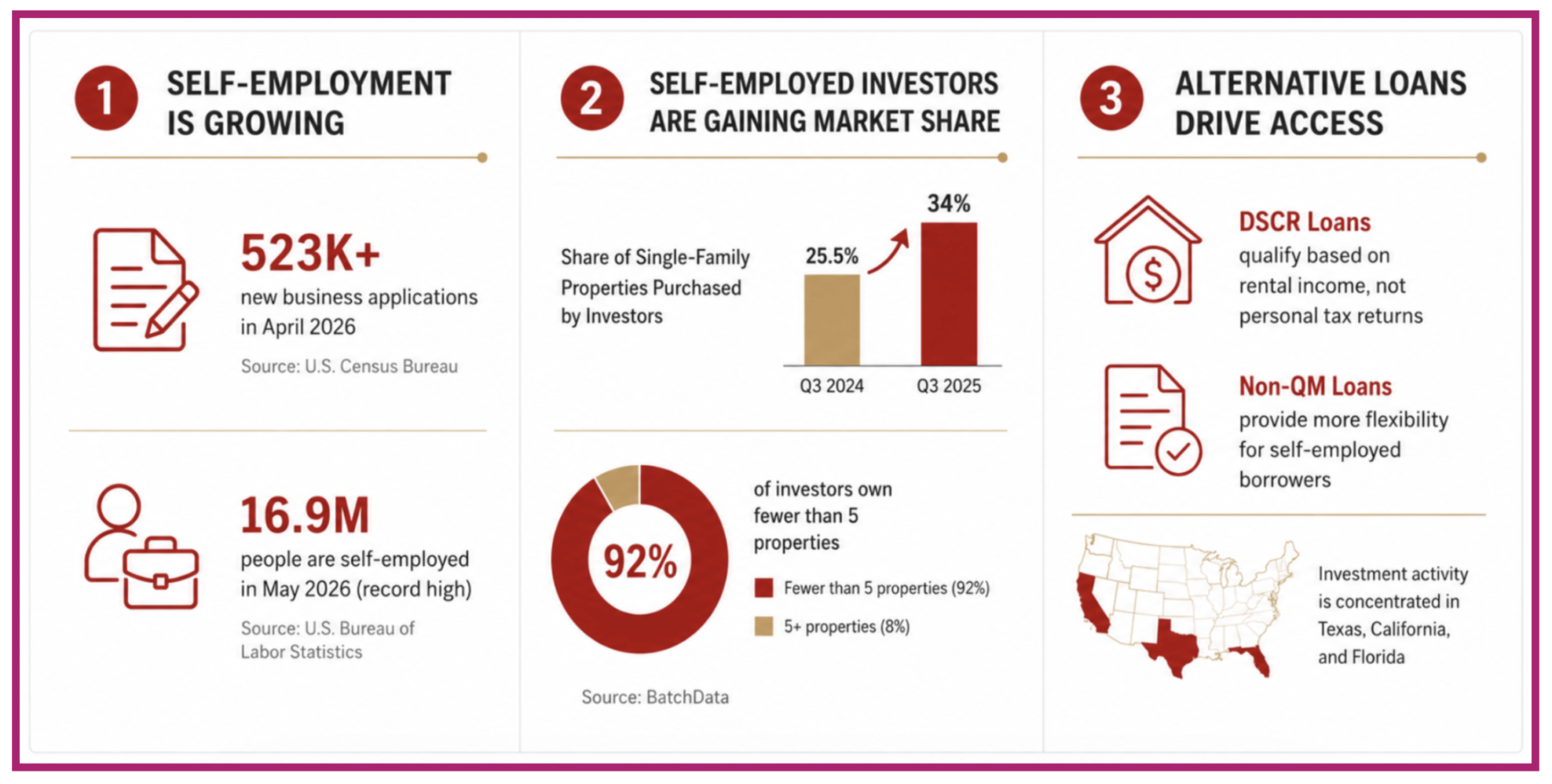
Data from the U.S. Census Bureau indicates that nearly 524,000 new business applications were filed in May 2026. The vast majority of these, over 70%, were classified as “other than high-propensity,” a category overwhelmingly composed of nonemployer firms and single-person entities.
The shift reflects multiple drivers, including the adoption of remote work and the growth of the gig economy, and has direct implications for other markets.
Griffin Funding, a mortgage and home loan lender, explored how the real estate investment sector is seeing an influx of new landlords from self-employed backgrounds, many of whom are looking to invest their capital in an asset that provides income stability and consistency not always available to freelancers.
Self-Employed Investors Are Capturing Record Market Share
Further data supporting the claim that more people are going freelance comes from the Bureau of Labor Statistics. Its latest news release for May 2026 shows that roughly 16.9 million people nationwide are self-employed, a new record.
Census data on new business formation, while useful, doesn’t fully capture self-employment trends.
Growth in self-employment is evident in real estate investor activity. Market info collated by BatchData indicates that 34% of single-family properties picked up in Q3 2025last year went to investors rather than owner-occupiers. That’s up from 25.5% in the same period of 2024, and represents a half-decade high for real estate investor activity.
BatchData also shows that 18% of the U.S. single-family housing stock is investor-owned. Institutional investors are not driving this trend. Instead, 92% of investors own fewer than five properties, with only 2% of the market accounted for by 1,000+ property investment behemoths.
Small-scale investors are snatching up market share and fueling rental availability, even as traditional W-2 retail buyers pull back due to affordability issues. And with purchases concentrated in Texas, California, and Florida, it’s very much a regionally driven trend.
Alternative Loans Open Real Estate Access for Freelancers
Modern financing options are accelerating access to real estate for self-employed investors.
Freelancers who may not be eligible for traditional financing packages can now take advantage of products like non-QM (non-qualified mortgages) and Debt-Service Coverage Ratio (DSCR) loans. DSCR loans are especially appealing because they qualify borrowers based purely on the property’s potential rental income rather than their personal tax returns. So, for self-employed individuals who may have wild fluctuations in income month to month, alternative lending options like these make real estate investment accessible.
DSCR loans fundamentally shift the underwriting model. Where traditional mortgages require stable W-2 income and extensive tax documentation, DSCR loans evaluate the property itself. A freelance consultant earning $120K one year and $80K the next would struggle with conventional financing.
But if that property generates $2,500/month in rental income, the DSCR calculation is straightforward: The property’s cash flow justifies the loan. This mechanic enables self-employed investors to build portfolios faster, since each acquisition stands on its own income merit rather than personal financial volatility.
Polygon Research estimates non-QM volumes now exceed $239 billion, or around 10% of the mortgage market as a whole.
The regional nature of this trend is explained by the way DSCR loans are approved. Higher rental yields and lower tax/insurance burdens make lending approval easier for self-employed investors.
Related: How investors finance the next purchase
How Self-Employment Is Reshaping Housing Supply
The boom in self-employment, coupled with non-QM and DSCR loans, has opened real estate investing to a new class of investors. The short-term implications include increased market activity, even as institutional property investors and smaller-scale landlords become increasingly cautious.
In the long term, this trend extends beyond property investors. Freelancers and contractors can choose lending packages that allow them to own rather than rent, expanding access to homeownership for a demographic that has previously struggled with traditional mortgage approval. It may stabilize housing markets, even in the face of inflationary pressures and rising interest rates.
Find the best loan for you. Reach out today!
Get Started
Bill Lyons is the Founder, CEO & President of Griffin Funding. Founded in 2013, Griffin Funding is a national boutique mortgage lender focusing on delivering 5-star service to its clients. Mr. Lyons has 25 years of experience in the mortgage business. Lyons is seen as an industry leader and expert in real estate finance. Lyons has been featured in Forbes, Inc., Wall Street Journal, HousingWire, and more. As a member of the Mortgage Bankers Association, Lyons is able to keep up with important changes in the industry to deliver the most value to Griffin's clients. Under Lyons' leadership, Griffin Funding has made the Inc. 5000 fastest-growing companies list six times in its 13 years in business. Follow his updates on LinkedIn.
 Outstanding Client Experience
 Specialized Lending Solutions
 Direct-to-Consumer Advantage
 We're Advisors, NOT Salespeople
 Effortless Digital Mortgage Platform
Featured In



Recent Posts
The rise of the five-house landlord: Wall Street blinked, small investors kept buying
In a single month, America’s biggest landlords cut their share of home purchases nearly in half. Firms t...

Mortgage rates hit 18% in 1981. Here’s how that compares with buying a home today
Borrowers shopping for a 30-year fixed mortgage in the fall of 1981 saw rates peak at 18.63% in the week of Oc...
Average home equity gains topped $200,000 in six states as renters faced heavy housing costs
A rising home value can mean two very different things on the same street. For an established homeowner, it ca...