






Homeowners who won’t give up a 3% mortgage are becoming landlords instead
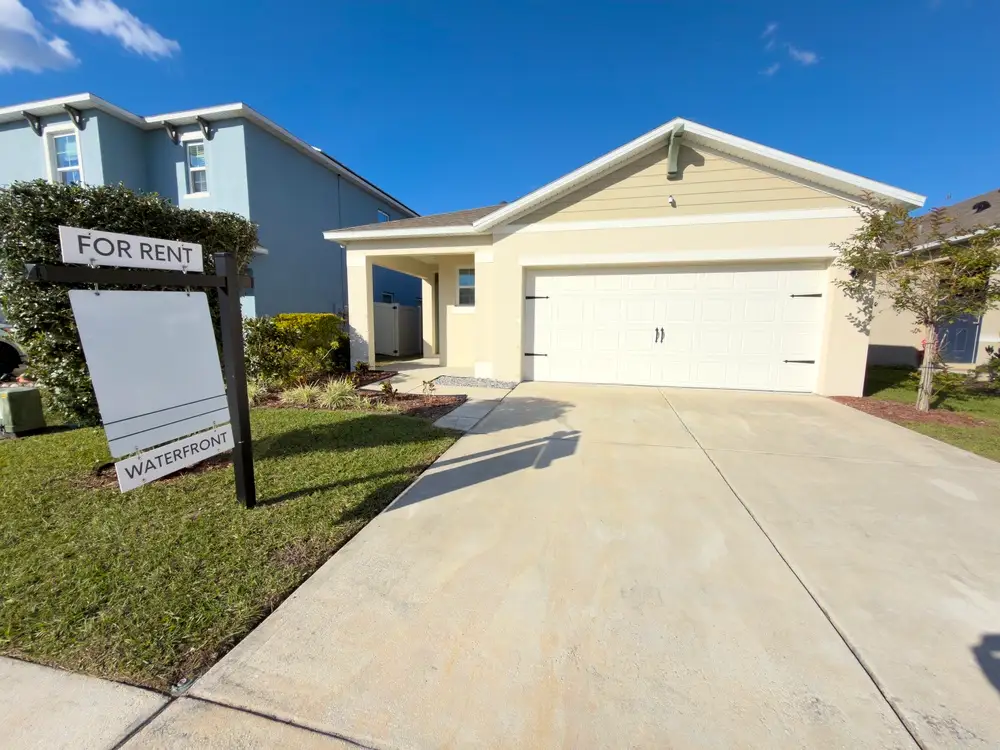
Some homeowners have started treating moving and selling as two separate decisions. A job moves to another city, a family outgrows the bedrooms, aging parents need someone closer. So the owner buys somewhere else and rents the old house out instead of listing it. Often, part of the reason is sitting in the loan documents.
 Written by Bill Lyons


Griffin Funding reviewed federal mortgage data, rental listing trends, economic research on rate lock-in and Fannie Mae’s new underwriting rules to see what’s pushing owners in this direction and who can actually qualify to do it. The review shows the cheap loan explains why so many owners want to hold on. Whether they can comes down to something less obvious. Under Fannie Mae’s updated rules, keeping the old house takes documented market rent and months of cash reserves, and a tenant who covers the payment may not be enough on paper.
The unsold house becomes a rental
Zillow calls these owners accidental landlords, and its research on accidental landlords uses a narrow definition. A home counts if it sat on the market for at least two weeks, came off unsold, and showed up as a rental within three months. Those homes made up 2.3% of Zillow’s rental listings in October 2025, matching the October high from 2022. Only November 2022 ran higher in nearly six years of data, and Zillow says the trend may not have peaked.
The share is small. What stands out is the direction. It’s back near late-2022 levels, the last time the market froze. And Zillow’s count only catches owners who tried to sell first. It misses the ones who never listed at all because the math on their mortgage told them not to bother.
Zillow pins most of the recent increase on a softer sales market. Buyers have more leverage, homes sit longer, and renting the place out buys time without a price cut. The geography backs that up. Denver leads at 4.9%, and seven of the top 10 metros are in Texas or Florida, where price cuts are common. Providence, Boston and New York, all tight markets, have the lowest shares.
That geography comes with an awkward catch. Cotality’s latest single-family rent report, covering August, shows the South with the weakest rent growth in the country. Only two markets posted annual rent declines, and both were in Florida: Cape Coral-Fort Myers and North Port-Sarasota. Houston, second on Zillow’s list, managed just 0.6%, the lowest among major metros. Chicago, up 4.9%, led them. So the markets turning out the most accidental landlords are, broadly, the ones where rents are softest.
Zillow also flags a second force. Owners who bought or refinanced at 3% or less carry payments low enough that rent can cover them. That force is the mortgage itself, and it’s what can turn a stopgap into a long-term arrangement.
The loan is worth more than the sale
At the end of June, 49.1% of outstanding U.S. mortgages carried a rate below 4%, according to the Federal Housing Finance Agency’s National Mortgage Database. Roughly one in five still sits below 3%, though loans above 6% now make up 22.5% of the total and outnumber them. Meanwhile, the average 30-year fixed rate climbed to 7.40% in Freddie Mac’s Oct. 8 survey, the highest since November 2023, up from 6.95% in mid-September. It was still 7.24% as of Oct. 29.
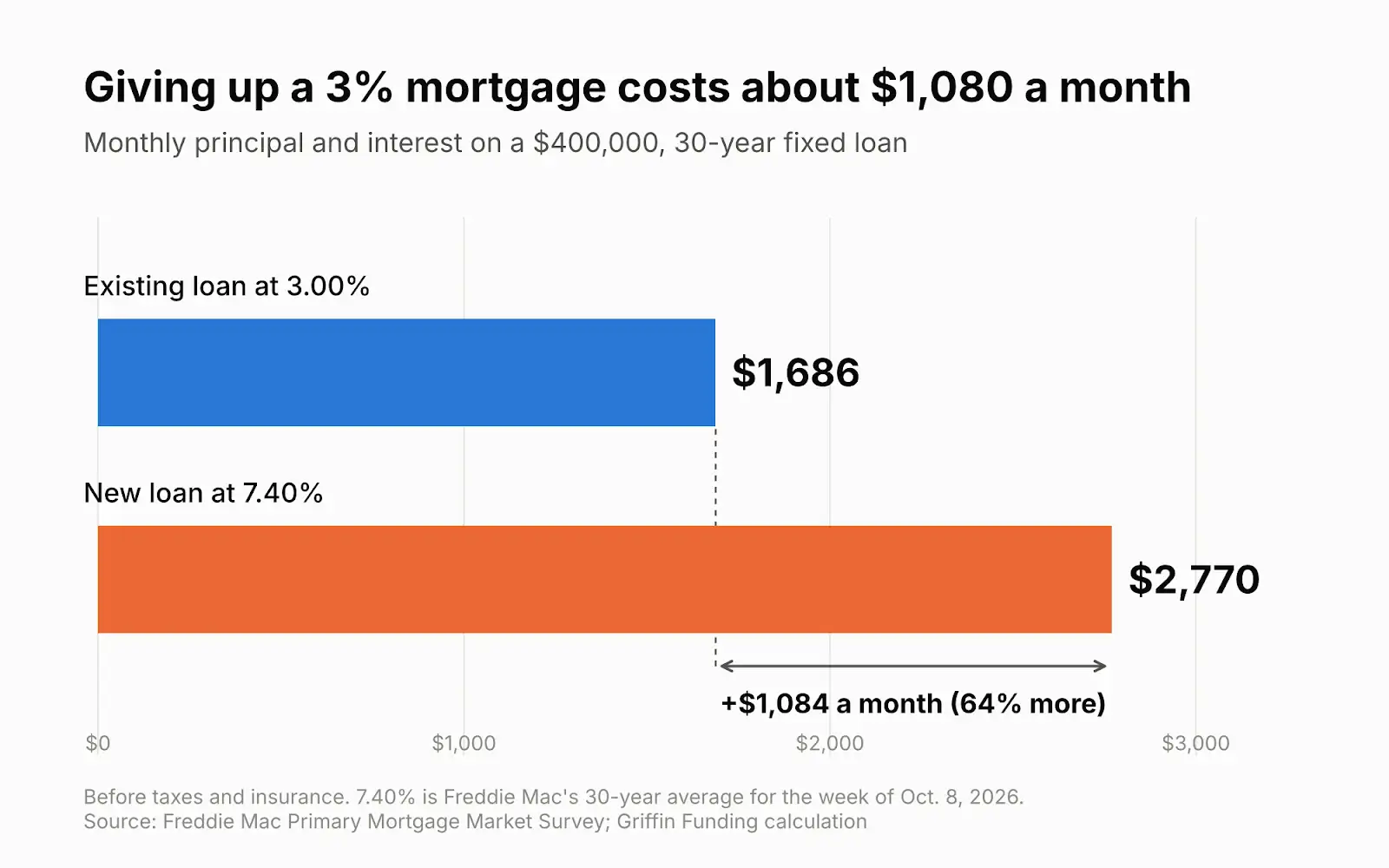
Put that on a $400,000 loan with a 30-year term. At 3%, principal and interest run about $1,686 a month. At 7.40%, the same loan costs about $2,770. That’s roughly $1,080 more every month, or 64% higher, before price, taxes or insurance come into it. Selling ends the old loan. Renting the house out keeps it.
The cheap mortgages are draining out slowly
Low-rate loans were supposed to work their way out of the system on their own. People would sell for all the usual reasons, the stock would shrink, and the market would loosen. That’s happening, just slowly.
The share of mortgages below 4% peaked at about 65% in early 2022. It slipped under half in the first quarter of 2026, landing at 49.9%, and was down to 49.1% three months later. Part of that drop comes from new, higher-rate loans joining the pile, not only cheap ones getting paid off. Either way, the share moves by fractions of a point per quarter. And with rates climbing again this fall, the gap only got wider for everyone still holding a cheap loan.
What the research says it has cost
A revised FHFA working paper on the lock-in effect by Ross Batzer, Jonah Coste, William Doerner and Michael Seiler found that for every percentage point market rates sit above a homeowner’s fixed rate, the probability of that homeowner selling falls by 18.1%.
Scaled across the market, the authors estimate lock-in prevented about 1.72 million sales between the second quarter of 2022 and the second quarter of 2024. They also estimated that keeping that supply off the market raised home prices by about 7.0%. The authors note that kind of affordability squeeze tends to land hardest on first-time and lower-income buyers.
Kristopher Gerardi of the Federal Reserve Bank of Atlanta, Franklin Qian of the University of North Carolina and David Zhang of Rice University came at it from another direction. Their Atlanta Fed working paper on lock-in and household moves used a model of local housing markets to estimate that lock-in cuts the odds a homeowner lists at all by 21% to 23%. By the same estimate, when locked-in owners do list, their homes stay on the market 52% to 142% longer.
How lenders count rent from the home you leave behind
Keeping the old house and buying a new one sounds simple. Qualifying is harder. It mostly comes down to whether rent from the departing home covers enough of its payment for the borrower to carry both.
Fannie Mae recently rewrote its answer. Announcement SEL-2026-08, issued Sept. 2, replaced its guidance on departing residences with a new rental income framework in its Selling Guide, section B3-3.8-05. Fannie encouraged lenders to start using it right away, then updated the announcement on Sept. 23 to make it mandatory for applications dated Dec. 1, 2026, or later.
Leases no longer count for a departing residence. Market rent has to come from an appraisal with market rents, a Single-Family Comparable Rent Schedule, or market analysis tools using at least three comparable rentals. That fixes an old chicken-and-egg problem, since most homeowners don’t have a signed tenant before they close on the next house.
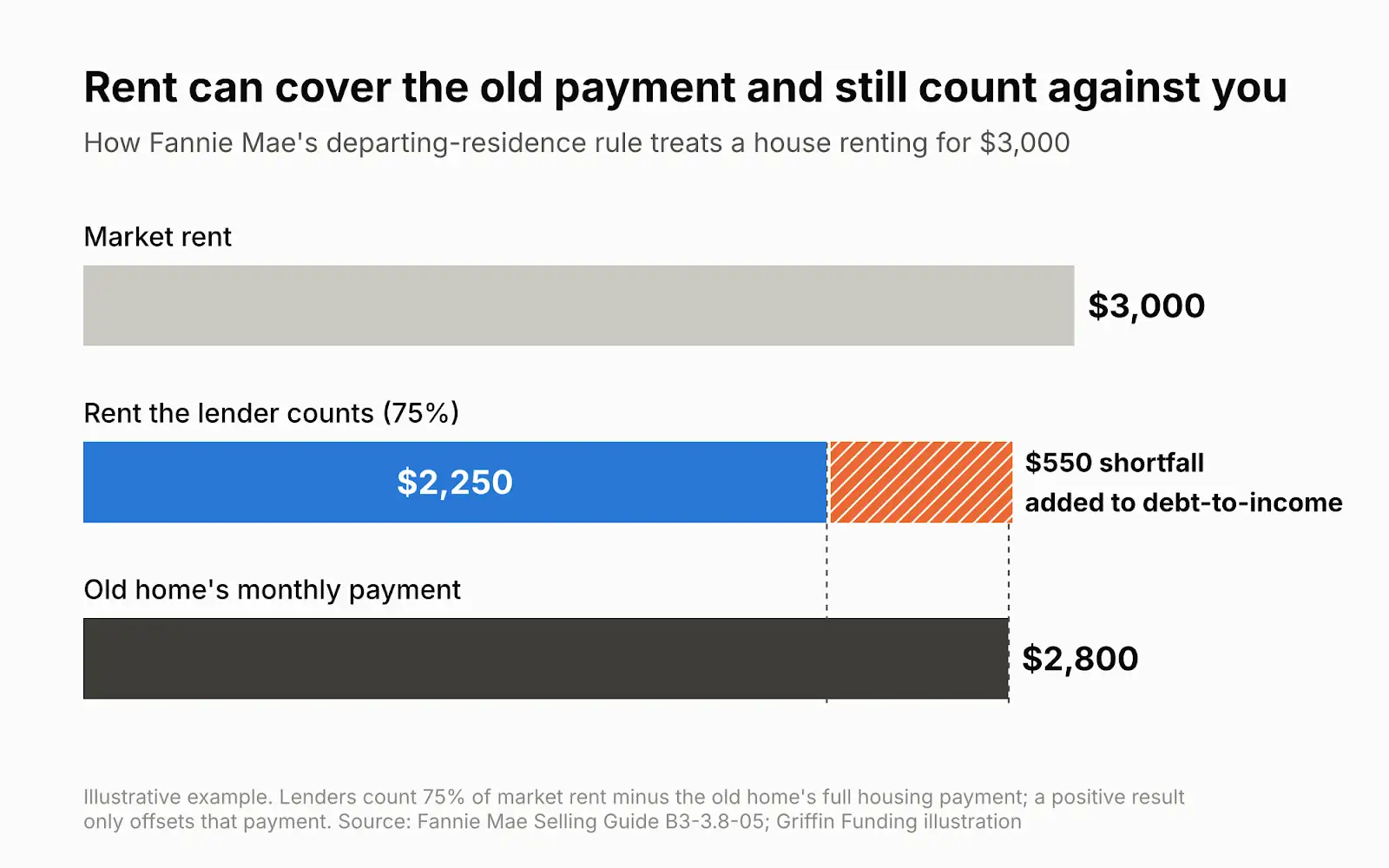
The math has a ceiling. The lender takes 75% of gross market rent and subtracts the old home’s full housing payment. If what’s left is positive, it can offset that payment and nothing beyond it. If it’s negative, the shortfall goes into the borrower’s debt-to-income ratio.
That catches people off guard. Say the old house rents for $3,000 a month and the payment is $2,800. On paper, the rent covers it. Under the formula, 75% of $3,000 is $2,250, which leaves a $550 monthly shortfall that counts against the borrower.
Reserves are spelled out now, too. A borrower with less than 12 months of property management experience needs six months of reserves covering the vacated home’s housing payment, on top of any reserves required for other financed properties. On that $2,800 payment, that’s $16,800 in verified assets left over after the down payment and closing costs on the new home.
For borrowers whose finances fit that framework, a conventional loan on the new home still works. Others run into problems that have little to do with credit. A self-employed borrower whose tax returns show income after deductions can look thinner on paper than the business really is. A borrower carrying two homes can hit debt-to-income limits that the rent, capped at offsetting the old payment, can’t fix.
Some of those borrowers turn to non-QM loans, which qualify people using different documentation. A bank statement loan on the new home, for example, looks at business deposits instead of tax returns, and the low-rate loan on the old house stays put. Refinancing the departing home into a debt-service coverage ratio loan, which qualifies a rental on its own rent, usually defeats the purpose, since it replaces the cheap mortgage the owner was trying to keep. DSCR loans tend to come in later, if the accidental landlord decides to buy another rental and doesn’t want each new property piled onto their personal debt-to-income ratio. None of this settles whether keeping the house is smart. It changes what the lender looks at.
Keeping it is not automatically the right call
A cheap mortgage is a real asset, but it doesn’t make anyone a good landlord. Vacancy, repairs, management, insurance, taxes and the chance of carrying two payments between tenants all sit on the other side of the ledger. Rent growth isn’t doing much to help. Cotality’s August figures put national single-family rent growth at 2.0% year over year, just under the 2.1% of a year earlier and only at the low end of its long-run range, with wide swings by region.
The new reserve rule points the same way. Fannie Mae wants a borrower carrying two properties to be able to ride out a rough stretch.
Lock-in looks structural now
Lock-in was first treated as a temporary side effect of how fast rates rose in 2022. Four years later, with cheap loans draining out slowly and rates climbing again, it looks like a long-term feature of the market. Fixed-rate mortgages last decades. Unless rates fall substantially, millions of households will keep holding loans priced far below anything a new borrower can get.
The effects reach past home sales. Lock-in shapes where people take jobs, when families move, how many homes come up for sale, and, more and more, who ends up owning a rental without ever setting out to be an investor. The next chapter of this market may be less about homeowners finally giving up their cheap mortgages and more about what they’ll do to hold on to them.
Bill Lyons, President and CEO, Griffin Funding. NMLS# 358687, Forbes Real Estate Council, HousingWire Top 50 Executives in Housing.
Find the best loan for you. Reach out today!
Get Started
Bill Lyons is the Founder, CEO & President of Griffin Funding. Founded in 2013, Griffin Funding is a national boutique mortgage lender focusing on delivering 5-star service to its clients. Mr. Lyons has 25 years of experience in the mortgage business. Lyons is seen as an industry leader and expert in real estate finance. Lyons has been featured in Forbes, Inc., Wall Street Journal, HousingWire, and more. As a member of the Mortgage Bankers Association, Lyons is able to keep up with important changes in the industry to deliver the most value to Griffin's clients. Under Lyons' leadership, Griffin Funding has made the Inc. 5000 fastest-growing companies list six times in its 13 years in business. Follow his updates on LinkedIn.
 Outstanding Client Experience
 Specialized Lending Solutions
 Direct-to-Consumer Advantage
 We're Advisors, NOT Salespeople
 Effortless Digital Mortgage Platform
Featured In



Recent Posts
Homeowners who won’t give up a 3% mortgage are becoming landlords instead
Griffin Funding reviewed federal mortgage data, rental listing trends, economic research on rate lock-in and F...

What podcasters, streamers, and full-time creators need to know about qualifying for a mortgage
Among 1,000 U.S. creators surveyed in January 2026 by The Influencer Marketing Factory, 23.8% had been creatin...
The rise of the five-house landlord: Wall Street blinked, small investors kept buying
In a single month, America’s biggest landlords cut their share of home purchases nearly in half. Firms t...