

Understanding DSCR loans: How cash-flow underwriting works for rental properties
Understanding DSCR loans: How cash-flow underwriting works for rental properties

 Written by Bill Lyons



The property investment market is going through a period of uncertainty, with Q1 of 2026 being the quietest period since the disruption caused by the COVID-19 pandemic brought house sales to a halt, according to data from Redfin cited by Newsweek. The previous low point for the market in terms of investor activity, discounting the anomaly of the pandemic, was 10 years ago, and between January and March the year-on-year change in sales was -6%.
One of the barriers to entry that new property investors have, as well as an obstacle that prevents existing investors from expanding their rental property portfolio, is access to capital. An individual might know that there’s an opportunity to buy a home and generate decent returns via rent, covering financing costs and turning a profit in the process, but getting approved for a traditional mortgage in this scenario comes with a whole host of eligibility implications, not to mention tax obligations.
Debt service coverage ratio (DSCR) loans are an alternative to standard institutional mortgages and can be a good fit for investors looking to buy into rental properties. With the market slowing, now may be the time for keen investors to act. Griffin Funding, a mortgage and home loan lender, broke down exactly what DSCR loans are and how they function in a rental property investment context.
The Basics of Cash-Flow Underwriting
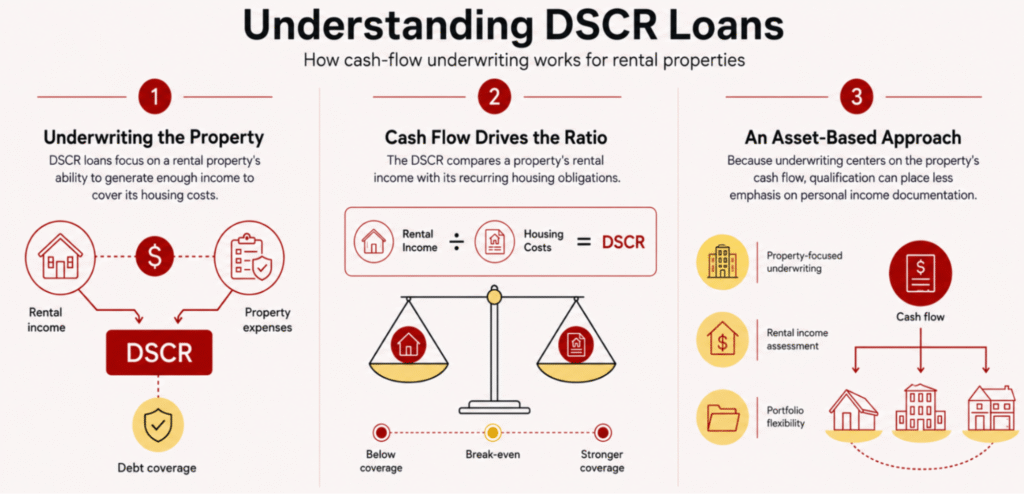
Cash-flow underwriting evaluates a rental property based on its ability to generate income rather than the personal income of the borrower. Instead of calculating debt-to-income ratios using W-2s and tax returns, lenders analyze the DSCR to determine if the asset pays for itself.
DSCR is calculated by dividing gross monthly rent by monthly PITIA (principal, interest, taxes, insurance, and association dues). When a property’s gross rent matches its total housing obligation, the ratio sits at 1.0. A ratio above 1.25 indicates strong monthly cash flow, earning borrowers lower interest rates and lower equity requirements.
A Closer Look at DSCR Calculations
To qualify for an investor mortgage, the property must undergo a physical appraisal alongside a market rent analysis via Fannie Mae Form 1007. The appraiser reviews local comparable leases to establish the fair market rent, which forms the gross monthly income baseline for underwriting.
For a three-bedroom single-family rental grossing $3,000 in monthly rent with a calculated $2,400 total PITIA, the math breaks down as the $3,000 rent divided by the $2,400 PITIA, providing a DSCR ratio of 1.25. Lenders set their own program parameters around this coverage metric. Ratios at 1.25 or higher generally unlock a lender’s best pricing and its lowest down payment. Ratios between 1.00 and 1.24 still cover the monthly obligation, though lenders tend to respond with a higher credit requirement or a lower loan-to-value limit. Below 1.00 the property runs a monthly deficit, and lenders willing to write the loan ask for a larger down payment and deeper reserves to offset it.
Even when rental figures fall below break-even thresholds, specialized debt-coverage options allow capital deployment into value-added acquisitions. Such flexibility is key to enabling investors to capitalize on opportunities that present themselves, especially if they can determine that the long-term prospects of a rental property promise significant returns that aren’t reflected in its current valuation.
Appreciating the Qualification Criteria
While cash-flow underwriting waives traditional employment verification, lenders offset that by tightening asset and credit requirements. DSCR loans sit outside agency guidelines, so there is no single national standard and the baselines vary by lender. Most programs start around a 640 credit floor, though some lenders go lower. Down payment requirements typically range from 20% to 25%, but they sit at each lender’s discretion and move with credit tier. A stronger score buys a smaller down payment, while borrowers near the bottom of a lender’s range should expect to put more in. Griffin Funding, for example, sets its own floor at 620 and allows borrowers with optimal credit to go as low as 15% down. Reserves are the most consistent requirement, typically three to six months of PITIA held after closing.
Those requirements apply to a fast-growing slice of the market. Investor and DSCR loans made up 33.5% of non-QM loan volume in recent lock data.
The Tax Angle
Conventional mortgages cap investors at 10 financed properties while penalizing tax write-offs that lower net reported income. Cash-flow underwriting removes these barriers, allowing self-employed borrowers and entity-based investors to scale without tax return scrutiny.
Self-employed buyers frequently leverage nonconforming cash-flow loans to qualify without personal income documentation. Because qualification ties to the property rather than the borrower, investors can close through an LLC or another entity, which with most lenders keeps the mortgage off their personal credit report. Most DSCR lenders still require a personal guarantee on entity-vested loans, so the separation is about how the debt is reported rather than who is ultimately liable.
An Ongoing Market Opportunity
In short, cash-flow underwriting transforms how real estate portfolios grow by anchoring loan approvals directly to the income potential of individual assets. In removing debt-to-income hurdles and personal tax review, investors gain a streamlined mechanism for acquiring properties based on real market revenue. And with the market slowing down, those in a position to capitalize on buyers being in a stronger position should consider this an appealing option.
Find the best loan for you. Reach out today!
Get Started
Bill Lyons is the Founder, CEO & President of Griffin Funding. Founded in 2013, Griffin Funding is a national boutique mortgage lender focusing on delivering 5-star service to its clients. Mr. Lyons has 25 years of experience in the mortgage business. Lyons is seen as an industry leader and expert in real estate finance. Lyons has been featured in Forbes, Inc., Wall Street Journal, HousingWire, and more. As a member of the Mortgage Bankers Association, Lyons is able to keep up with important changes in the industry to deliver the most value to Griffin's clients. Under Lyons' leadership, Griffin Funding has made the Inc. 5000 fastest-growing companies list six times in its 13 years in business. Follow his updates on LinkedIn.
 Outstanding Client Experience
 Specialized Lending Solutions
 Direct-to-Consumer Advantage
 We're Advisors, NOT Salespeople
 Effortless Digital Mortgage Platform
Featured In



Recent Posts
Average home equity gains topped $200,000 in six states as renters faced heavy housing costs
A rising home value can mean two very different things on the same street. For an established homeowner, it ca...

A 1-percentage-point mortgage rate rise can outrun 4 years of rent growth
The Federal Reserve raised interest rates on Sept. 16 for the first time since 2023. For rental property inves...
Conforming mortgages just lost their majority. Non-QM is helping drive the shift
Conforming mortgages accounted for nearly three-quarters of Optimal Blue’s rate-lock volume in July 2020...