

Mid-Term Rentals: Guide for Real Estate Investors
 Written by Bill Lyons
KEY TAKEAWAYS
- Mid-term rentals typically run 30 days to 12 months, offering furnished accommodations to traveling professionals, remote workers, and relocating families.
- These properties generate 20-40% higher monthly revenue than traditional long-term rentals and require less management than short-term rentals.
- DSCR and specialized investment property loans make financing mid-term rentals accessible for real estate investors.











 Outstanding Client Experience
 Specialized Lending Solutions
 Direct-to-Consumer Advantage
 We're Advisors, NOT Salespeople
 Effortless Digital Mortgage Platform
Mid-term rentals represent a strategic middle ground in real estate investing, offering the stability of traditional leases with the premium pricing of short-term stays. This guide explores how these flexible housing options can help you build wealth while serving professionals, remote workers, and relocating families. You’ll learn about profitability analysis, financing strategies, and actionable steps to launch your mid-term rental business.
What Is a Mid-Term Rental?

Mid-term rentals are furnished properties leased for 30 days to 12 months, targeting traveling professionals, remote workers, and relocating families who need temporary housing. These types of rentals bridge the gap between short-term rentals and traditional year-long leases while targeting professionals who need temporary housing but want more stability than nightly bookings provide. Mid-term rentals operate on monthly contracts that reduce management demands.
This matters for investors because mid-term rentals face fewer regulatory hurdles than short-term vacation properties in many markets. Cities like San Diego and Austin that restrict 30-day-or-less rentals often allow mid-term leases without special permits.
This regulatory advantage combines with lower turnover costs to create a compelling investment model. Plus, investors who traditionally use Airbnb loans for vacation rentals find mid-term properties offer similar returns with fewer management headaches.
Types of Mid-Term Rental Properties
Different property types serve the mid-term rental market with varying levels of success.
- Single-family homes: These properties offer the highest appeal for families relocating or professionals on extended assignments. They command premium rents in suburban markets near major employers, hospitals, or universities. The privacy and space attract quality tenants willing to pay above-market rates for furnished accommodations.
- Condos and townhomes: These provide turnkey mid-term rental opportunities in urban centers where traveling nurses and corporate consultants concentrate. Lower maintenance requirements make these properties easier to manage remotely. HOA amenities like pools and fitness centers add value without increasing your workload.
- Multifamily units: These allow you to diversify risk by housing multiple mid-term tenants simultaneously. A fourplex can serve different tenant types in each unit, stabilizing cash flow even during seasonal demand fluctuations. Non-qualified mortgages may offer flexible financing for these larger properties.
- Accessory dwelling units (ADUs): These maximize property value by converting garages, basements, or backyard structures into income-generating mid-term rentals. These smaller units appeal to solo traveling professionals and remote workers seeking affordable furnished options.
Who Is the Target Audience for Mid-Term Rentals?
The mid-term rental strategy for landlords focuses on five primary tenant types who need temporary furnished housing.
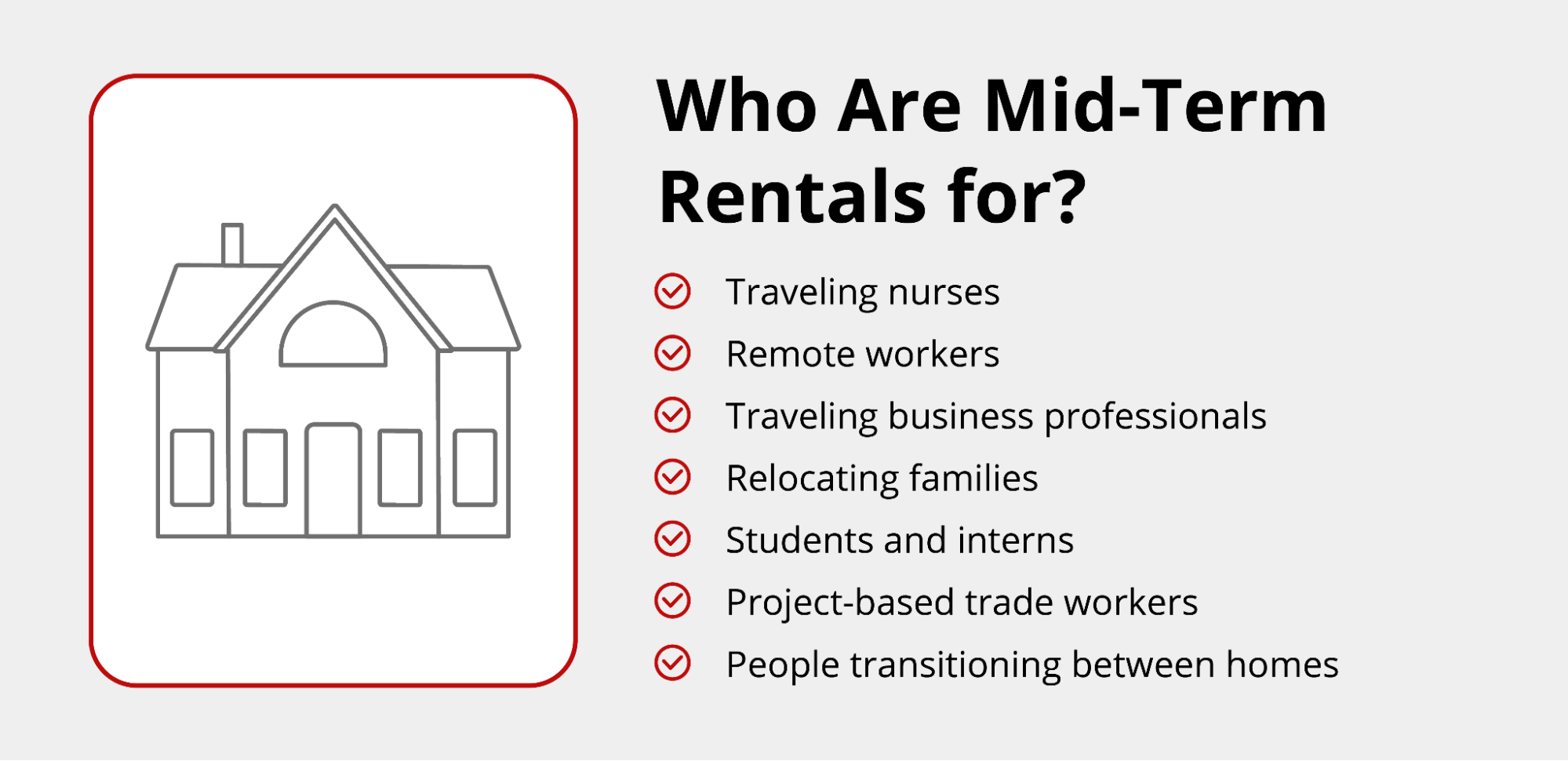
- Traveling nurses and healthcare professionals: These tenants represent the most reliable mid-term rental demographic. They book 13-week assignments through agencies that often provide housing stipends.
- Corporate employees and consultants: These professionals need furnished housing during project assignments, training programs, or office relocations. Tech hubs, consulting centers, and corporate headquarters generate consistent demand.
- Remote workers and digital nomads: These tenants seek flexible lease apartments that provide home office capabilities and location independence. They prioritize internet speed, comfortable workspaces, and neighborhood amenities over proximity to specific employers.
- Families relocating or renovating: These tenants require temporary housing during home purchases, sales, or major remodels. They often need larger properties and may stay three to six months.
- Insurance displacement tenants: These tenants need immediate housing after fires, floods, or other disasters while their homes undergo repairs. Insurance companies typically pay premium rates for furnished accommodations, making this segment highly profitable.
Best Neighborhoods for Mid-Term Rentals
Location selection directly impacts occupancy rates and rental premiums. Target properties within:
- 3-5 miles of major hospitals for traveling nurse demand.
- Corporate office parks housing Fortune 500 headquarters or regional offices.
- University districts serving visiting faculty and graduate students.
- Downtown areas attracting remote workers seeking walkable neighborhoods.
Avoid tourist-heavy beach towns where regulations may tighten and seasonal demand creates cash flow volatility.
Are Mid-Term Rentals Profitable?
Mid-term rental profitability depends on your property location, financing terms, and operational efficiency. Average pricing for mid-term rentals runs 20-40% higher than comparable unfurnished long-term rentals.
Vacancy rate advantages separate mid-term rentals from short-term properties, averaging 10-15% annually compared to 25-40% for vacation rentals. The extended lease terms mean you book each tenant only 4-6 times per year instead of managing dozens of guest turnovers.
For example, a three-bedroom home in Denver generating $3,200 monthly rent faces roughly $1,200 in mortgage payments, $150 in utilities, $100 in internet and streaming services, $50 in monthly cleaning, and $100 in maintenance reserves. Your net monthly cash flow reaches approximately $1,600 before taxes.
Use an estimated rent calculator to model your specific market conditions and financing terms.
 Mid-Term vs Short-Term Rentals
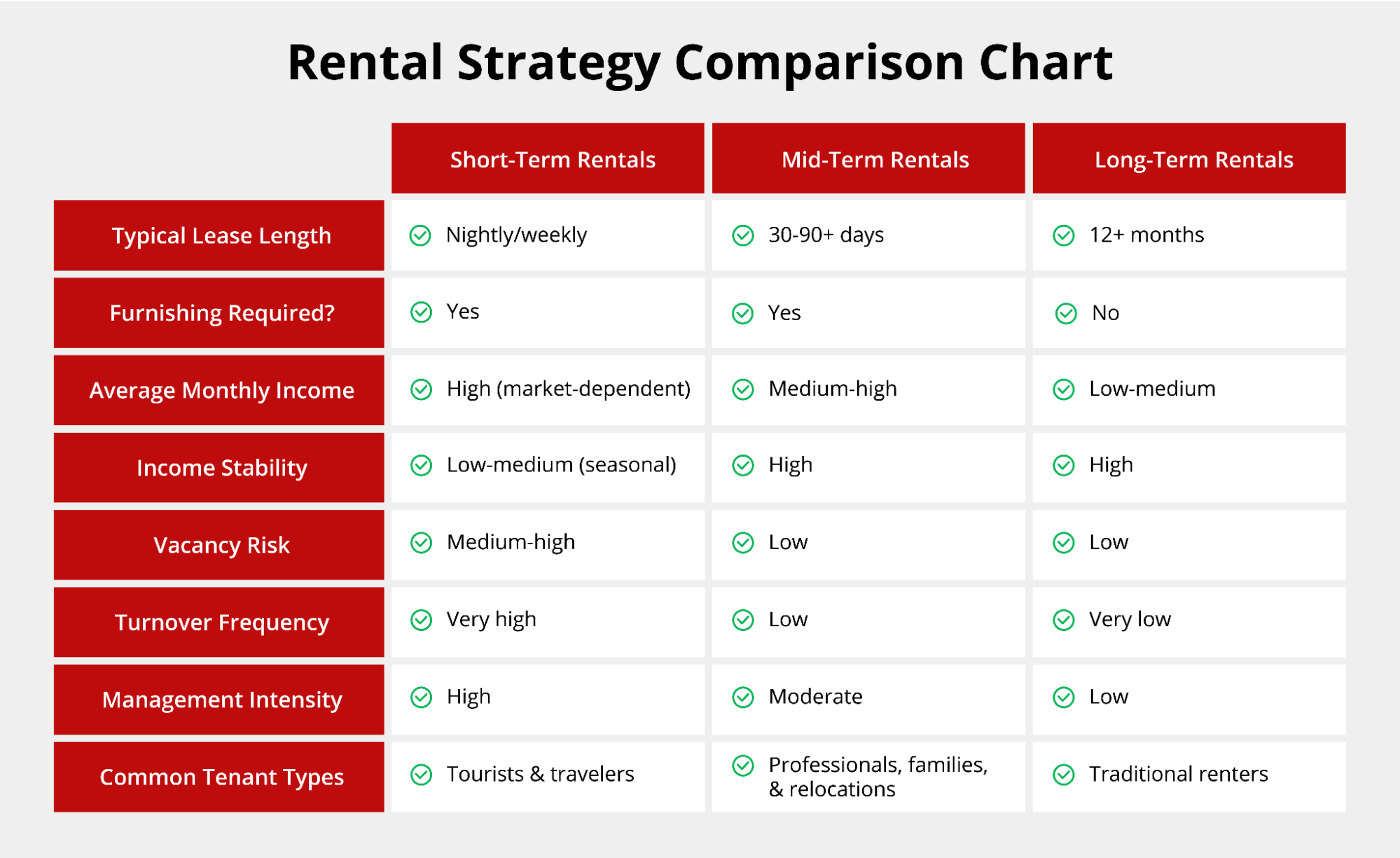
Income stability differentiates mid-term rentals from short-term vacation properties. Short-term rentals generate higher daily rates but suffer from seasonal demand fluctuations and unpredictable booking patterns. Mid-term rentals provide consistent monthly income with fewer gaps between tenants.
Management intensity drops dramatically with mid-term rentals since you eliminate nightly check-ins, constant communication, and frequent cleaning. Regulatory exposure poses significant risk for short-term rentals as cities tighten vacation rental rules, while mid-term rental regulations remain lenient in most markets.
Mid-Term vs Long-Term Rentals
Rent premiums make mid-term rentals more lucrative than traditional year-long leases. The 20-40% premium quickly offsets furniture costs and additional utilities you cover. This pricing power exists because your tenants need immediate, hassle-free housing solutions worth paying extra to secure.
Tenant quality typically exceeds long-term rental standards since mid-term renters often have corporate backing, professional credentials, or agency relationships. Lease flexibility allows you to adjust pricing seasonally and upgrade properties between tenants without breaking long-term contracts.
Pros and Cons of Medium-Term Rentals for Investors
The mid-term rental strategy offers distinct advantages and challenges that investors should evaluate carefully.
Pros
- Higher rents than long-term leases: The furniture premium and all-inclusive pricing model justify monthly rates that traditional landlords cannot command.
- Lower turnover than short-term rentals: You avoid the constant cleaning, restocking, and marketing that make vacation rentals management-intensive.
- Fewer local regulations: Most cities regulate rental properties based on lease length, with 30-day-plus agreements falling under standard landlord-tenant laws.
- More predictable cash flow: Corporate contracts and travel nurse assignments provide advance notice of occupancy, letting you plan maintenance and improvements during known vacancy periods.
Cons
- Furnishing costs: Quality furniture, kitchenware, linens, and décor for a three-bedroom property typically costs $8,000-15,000.
- Seasonal demand: Healthcare assignments cluster around hospital hiring cycles, and corporate projects follow business calendars.
- Shorter lease terms than traditional rentals: Each tenant transition requires property inspection, cleaning, and potential repairs.
How to Get Started With Mid-Term Rental Properties

Successfully launching a mid-term rental business requires planning across market selection, financing, and property preparation. Follow these steps to build a profitable portfolio:
- Market Research: Analyze employment centers in your target city to identify demand drivers. Major hospitals, corporate headquarters, consulting firms, and universities create consistent mid-term rental demand. Study both long-term rental rates and short-term rental performance to understand competitive pricing.
- Financing Your Mid-Term Rental: Consider investment property loans, DSCR loans, or portfolio loans depending on your financial situation. Traditional mortgages may also work if you have strong personal income and credit. Griffin Funding offers specialized financing solutions designed for rental property investors. DSCR loans are particularly well-suited for mid-term rentals because they qualify properties based on rental income rather than your personal income. This allows you to scale your portfolio faster, as lenders evaluate the property’s debt service coverage ratio (rent divided by mortgage payment) rather than your W-2 earnings. With mid-term rentals generating 20-40% premium pricing over traditional rentals, many properties easily achieve a 1.0-1.25 DSCR.
- Furnishing and Setup: Your property should feel move-in ready for someone arriving with only suitcases. High-speed internet is non-negotiable for remote workers. Provide all-inclusive utilities and streaming services to justify your rental premium. Schedule deep cleaning between tenants and create maintenance checklists to protect your furniture investment.
Find Out How to Start Investing in Mid-Term Rentals
Mid-term rentals offer real estate investors a profitable path between traditional landlording and short-term vacation rental management. The combination of premium pricing, reduced turnover, and flexible lease terms creates compelling investment returns.
Griffin Funding provides specialized financing solutions that recognize the unique economics of mid-term rental properties. Our investment property lending programs include DSCR products that evaluate properties based on rental income potential. The Griffin Gold app can also help you track expenses and monitor your investment performance.
Contact Griffin Funding or get started online today to explore financing options.
Find the best loan for you. Reach out today!
Get StartedFrequently Asked Questions
What is the typical lease length for a mid-term rental? 
Do mid-term rentals need to be furnished?
How do I know if a mid-term rental strategy is right for me?
What platforms are best for advertising mid-term rentals?
For corporate tenants, work directly with relocation companies, hospital staffing agencies, and corporate HR departments. Many successful mid-term rental investors use a multi-platform strategy, listing on 3-5 sites simultaneously to maximize exposure. Consider specialized platforms based on your property location—tech hubs perform well on Landing, while properties near major hospitals should prioritize Furnished Finder.
How do I calculate ROI for a mid-term rental property?
For example: A property generating $3,500/month with 88% occupancy yields $36,960 annual income. Subtract $18,000 mortgage, $3,000 taxes/insurance, $2,400 utilities, $1,200 cleaning, $3,000 maintenance, and $2,000 amortized furnishings = $7,360 annual cash flow. If your down payment was $50,000, your cash-on-cash return is 14.7%. Compare this to traditional rental returns in your market, factoring in appreciation and tax benefits. Use DSCR loans to leverage rental income for qualification rather than personal income.
What are the best cities for mid-term rental investing in 2025?
Healthcare hubs: Phoenix (Mayo Clinic), Houston (Texas Medical Center), Rochester MN (Mayo Clinic), and Nashville (Vanderbilt) generate consistent traveling nurse demand.
Tech centers: Austin, Denver, Seattle, and Raleigh-Durham attract remote workers and corporate consultants on project assignments.
Corporate headquarters: Dallas-Fort Worth, Atlanta, and Charlotte host Fortune 500 companies with frequent employee relocations and training programs.
Evaluate markets using these criteria: concentration of major hospitals (3+ within 20 miles), corporate headquarters presence, monthly rental rate premiums over unfurnished units (20%+ advantage), and local regulations allowing 30-day rentals without special permits. Avoid markets with aggressive short-term rental bans that may expand to include mid-term properties.
Do I need a property manager for mid-term rentals?
However, property managers make sense if you: own properties more than 2 hours away, manage 4+ mid-term rentals, lack time for tenant screening and coordination, or want to scale aggressively. Look for managers experienced specifically with furnished rentals and corporate housing—traditional landlords often lack the systems for mid-term operations. Expect to pay 10-15% of monthly rent versus 25-30% for short-term rental management.

Bill Lyons is the Founder, CEO & President of Griffin Funding. Founded in 2013, Griffin Funding is a national boutique mortgage lender focusing on delivering 5-star service to its clients. Mr. Lyons has 24 years of experience in the mortgage business. Lyons is seen as an industry leader and expert in real estate finance. Lyons has been featured in Forbes, Inc., Wall Street Journal, HousingWire, and more. As a member of the Mortgage Bankers Association, Lyons is able to keep up with important changes in the industry to deliver the most value to Griffin's clients. Under Lyons' leadership, Griffin Funding has made the Inc. 5000 fastest-growing companies list five times in its 12 years in business.
Recent Posts
LLC for Rental Property Purchase: Pros & Cons
What Is an LLC for Rental Property? A limited liability company (LLC) is a type of business structure that giv...

How to Get the Lowest Mortgage Rate: 7 Strategies
How Mortgage Rates Are Set Before we teach you how to get the lowest mortgage rate, it helps to understand wha...
What Is an Escalation Clause in Real Estate?
A real estate escalation clause is an addendum to a purchase offer that authorizes your bid to increase automa...