

How to Get the Lowest Mortgage Rate: 7 Strategies
 Written by Bill Lyons
KEY TAKEAWAYS
- Improving your credit score and debt-to-income ratio are the most powerful ways to qualify for better mortgage rates.
- The loan program you choose directly impacts your rate, with VA loans typically offering the lowest rates for eligible borrowers.
- Comparing loan estimates from at least three different lenders can uncover rate differences that save you thousands over the life of your loan.
- Strategic timing, larger down payments, and buying discount points can lower your rate if the circumstances are right.











 Outstanding Client Experience
 Specialized Lending Solutions
 Direct-to-Consumer Advantage
 We're Advisors, NOT Salespeople
 Effortless Digital Mortgage Platform
Part of shopping for a mortgage is finding the lowest rate you can qualify for. Even a small difference in your mortgage rate can add up to thousands of dollars over the life of your loan. The good news is that securing a competitive rate isn’t just about luck or timing.
Whether you’re a first-time buyer or refinancing your current home, understanding what lenders look for will put you in control when it comes to your mortgage. In this article, you’ll learn the most effective strategies for getting the lowest mortgage rate, plus common mistakes to avoid along the way. Keep reading to learn how to get the lowest mortgage rate.

How Mortgage Rates Are Set
Before we teach you how to get the lowest mortgage rate, it helps to understand what influences the rates lenders offer. Lenders look at broader economic conditions and your personal financial profile to determine your specific mortgage rate.
Here are the main factors affecting rates:
- Economic indicators: The Federal Reserve’s policies, inflation rates, and bond market performance help set baseline mortgage rates.
- Your credit profile: Higher credit scores and clean credit histories earn lower rates because they represent less risk.
- Loan characteristics: The type of loan, down payment amount, and property type all influence your rate.
- Lender competition: Different lenders have different pricing models, which is why rates vary from one company to another.
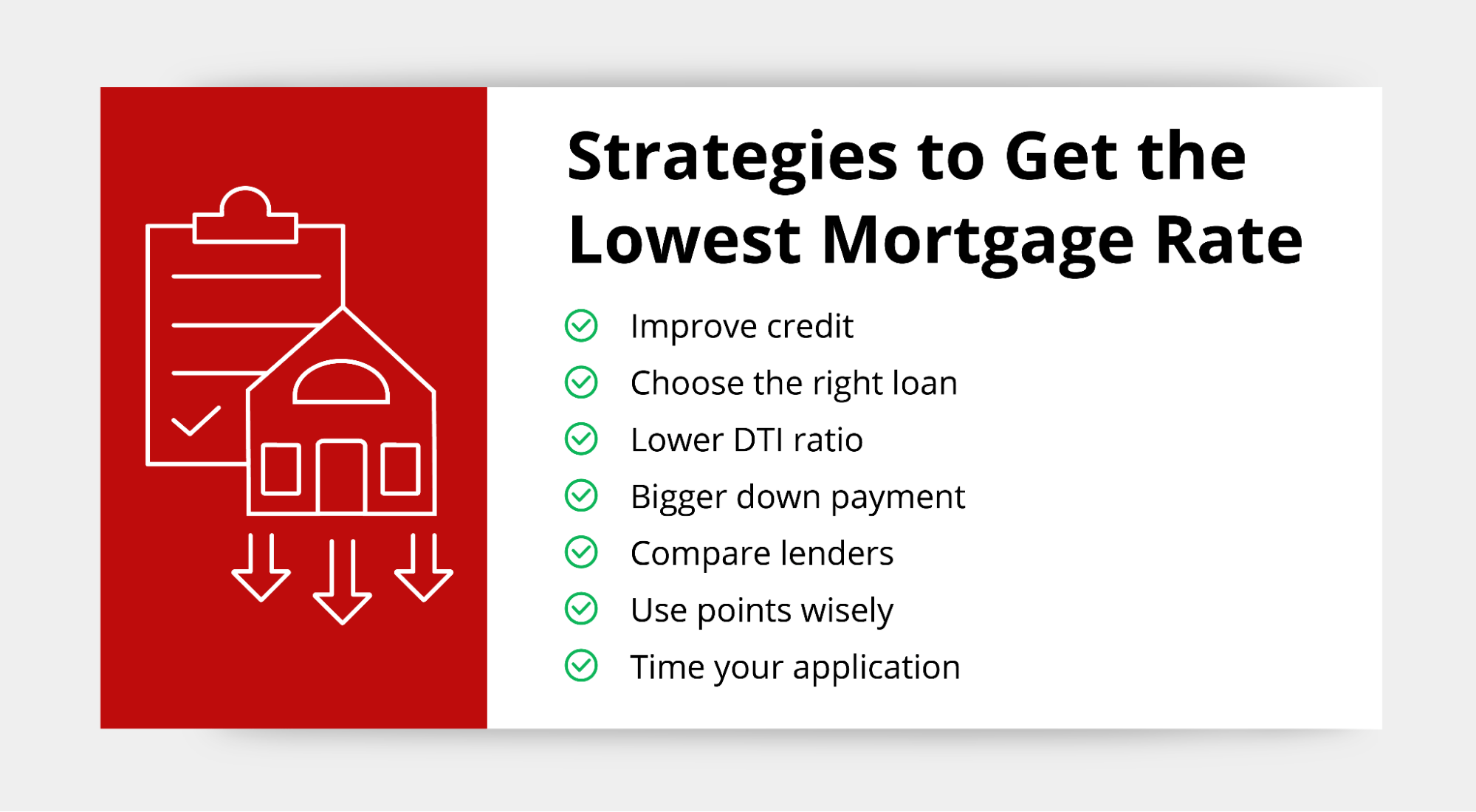 Strategy #1: Improve Your Credit Score Before Applying
If you’re here wondering, “How do I get the lowest mortgage rate?” you may or may not already know that your credit score influences everything from the car loan you qualify for to the interest rate on your credit card. Your mortgage rate is no exception.
As a general rule of thumb, the higher your score, the better your rate will be.
Borrowers with scores above 760 typically qualify for the best rates available. Scores between 700 and 759 get good rates, but not the absolute lowest. Below 700, you’ll start to see noticeable rate increases. The difference between a 680 and a 760 credit score can easily mean an extra $80,000 or more in interest over 30 years on a $400,000 loan.
Here’s how to improve your credit score before applying for a mortgage:
- Pay down revolving debt: Keep credit card balances below 30% of your limits. Below 10% is even better for your credit score.
- Avoid new credit inquiries: Hold off on opening new credit cards or auto loans while preparing to apply for a mortgage.
- Correct credit report errors: Pull your reports from all three bureaus and dispute any inaccuracies you find.
Strategy #2: Choose the Right Loan Program
The loan program you choose can significantly impact your rate. So, which loan type offers the lowest mortgage rate? Here’s what you can expect:
- Conventional loans: These typically offer competitive rates for borrowers with good or better credit and a 20% down payment.
- FHA loans: FHA loans are accessible with lower credit scores and 3.5% down, but they can come with slightly higher rates.
- VA loans: VA loans often provide the lowest available rates on the market with no down payment and no PMI.
- USDA loans: USDA loans offer competitive rates for eligible properties with no down payment required.
- Jumbo loans: These can be competitive with excellent credit and substantial assets.
Generally, traditional mortgages and non-qualified mortgages are for different borrower profiles. Non-QM loans help self-employed borrowers or those with complex finances, though rates tend to be higher.
Strategy #3: Lower Your Debt-to-Income (DTI) Ratio

Lenders use your debt-to-income ratio to assess whether you can afford your monthly mortgage payment. A lower DTI often results in better rate offers.
Most lenders like to see a DTI below 43% for conventional loans. If you can get your DTI below 36%, you’re in a stronger position to negotiate better terms.
Use our DTI ratio calculator to help you figure out where you stand.
Luckily, anyone can improve their DTI with these strategies:
- Pay off installment loans: Eliminating a car loan or student loan lowers your DTI and removes monthly obligations.
- Increase qualifying income: If you have side income that’s been consistent for at least two years, make sure your lender knows.
- Avoid taking on new debt: Don’t finance a new car or rack up credit card balances while preparing to buy a home.
Keep in mind that a low DTI tells lenders you have room to handle unexpected expenses. That reduced risk for them means lower rates for you.
Strategy #4: Save for a Larger Down Payment
“How can I get the lowest mortgage rate?” is one of the most common questions lenders hear, and down payment size is always a huge part of the answer. While the other strategies we’ve already covered help, your down payment directly impacts your rate. That said, the relationship isn’t always straightforward.
In general, putting down at least 20% eliminates private mortgage insurance on conventional loans. A larger down payment also results in a lower loan-to-value ratio, which can translate to a lower rate offer.
Keep in mind that it’s not necessary to make a 20% down payment if you can’t afford it. Draining savings to hit 20% isn’t always smart because you’ll want emergency funds and cash reserves. Sometimes, accepting a slightly higher rate while maintaining a financial cushion is wiser.
If you put less than 20% down, you can request PMI removal once you reach 20% equity.
Use our down payment calculator to see how different scenarios affect your costs.
Strategy #5: Compare Lenders and Loan Estimates
So, where can you get the lowest mortgage rate? You won’t know unless you shop around. Different lenders have different cost structures and pricing strategies. Even the most current mortgage rates are constantly changing, and if you don’t lock in your rate when you begin the application process, you can expect it to change throughout the process.
Lenders must provide a standardized Loan Estimate within three days of your application, which makes comparison shopping possible. When evaluating loan estimates, examine these factors:
- Interest rate: This is the percentage charged on your loan amount. It’s essentially what it costs to borrow the money. While it’s the most advertised number, it doesn’t include the various fees you’ll pay, which is why two loans with identical rates can end up costing very different amounts.
- APR: The annual percentage rate (APR) wraps your interest rate together with most closing costs and fees to show the true yearly cost of borrowing. A loan with a 6% interest rate but $5,000 in fees might have a higher APR than a 6.25% loan with minimal fees, meaning the second option actually costs less.
- Fees and points: These are the upfront charges lenders tack on beyond your interest rate, including origination fees, processing costs, underwriting fees, and optional discount points to buy down your rate. Lenders sometimes advertise eye-catching low rates while burying high fees in the fine print, so you need to look at the total cost.
Strategy #6: Consider Mortgage Points and Rate Locks

Understanding mortgage discount points can help you decide whether buying down your rate makes sense. One discount point equals 1% of your loan amount and typically reduces your rate by about 0.25%. So if you’re borrowing $300,000, one point would cost $3,000 upfront in exchange for a lower rate.
Whether that’s a smart move depends on how long you’ll have the loan. Calculate how long it takes for monthly savings to offset the upfront cost. If you’re paying $3,000 for points and saving $50 monthly, your break-even point is 60 months. If you plan to sell or refinance before that, buying points doesn’t make financial sense.
Points are most beneficial when you’re confident you’ll keep the loan for a long time and have available cash that isn’t needed for other purposes.
Strategy #7: Time Your Application Strategically
Timing can influence your rate more than you might expect. Keep an eye on the housing market and economic trends, particularly when the Federal Reserve signals policy changes. While the Fed doesn’t set mortgage interest rates, its decisions influence them significantly. Rates can swing noticeably in response to these announcements, and applying right before a likely rate increase could lock you into unnecessarily high costs.
Once you have a rate offer, you’ll face the decision to lock or float. A rate lock guarantees your rate for a specific period, protecting you from increases while you complete the loan process. If you’re satisfied with your rate and worried about upward movement, locking makes sense. On the other hand, if rates are trending downward and you have time before closing, letting your rate float could work in your favor.
There’s also a seasonal component to consider. Spring and summer typically see higher activity in the housing market, which can push rates slightly higher due to increased demand. Late fall and winter, when fewer people are house hunting, might offer better opportunities to secure a lower rate.
Common Mistakes That Prevent Borrowers From Getting the Lowest Mortgage Rate
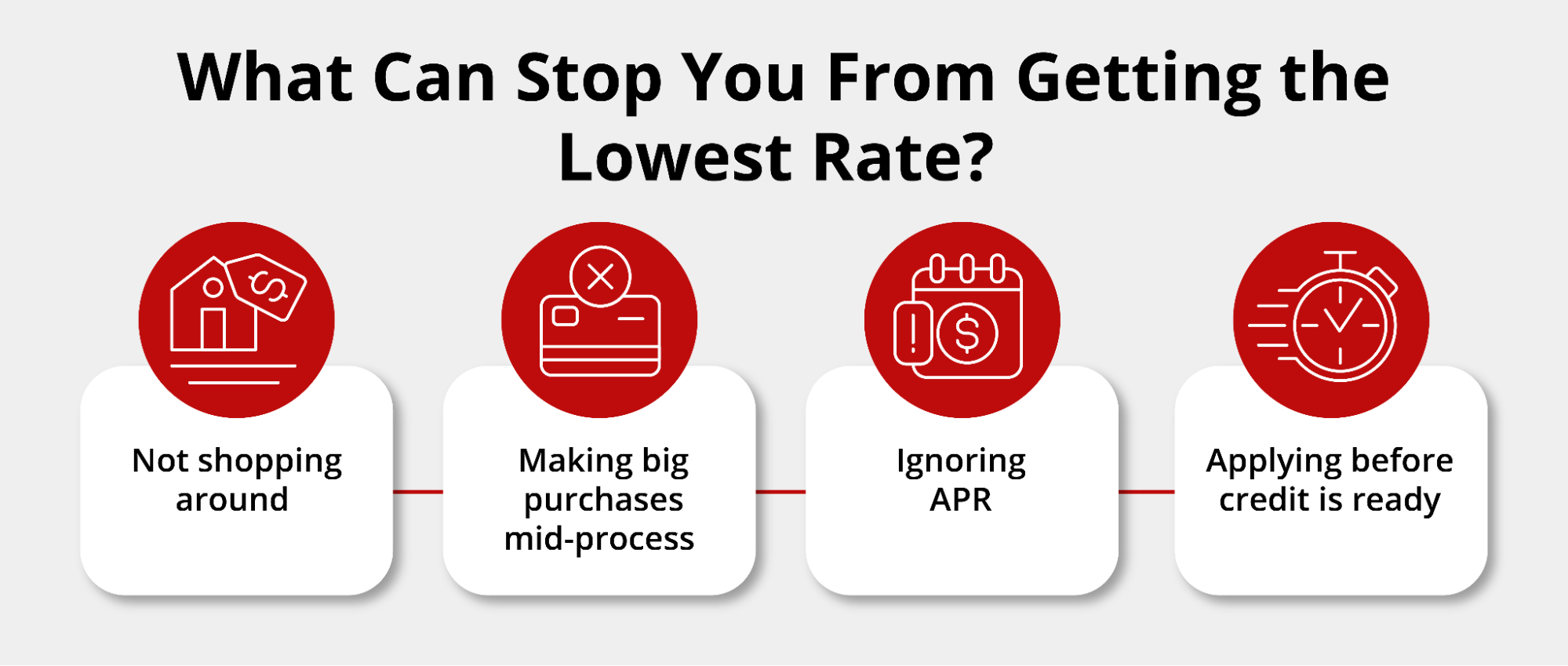 You can do everything right in terms of credit and down payment but still end up with a higher rate than necessary if you make one of these common mistakes:
- Applying with poor credit readiness: Submitting a mortgage application triggers a hard credit inquiry, which temporarily lowers your score. If you apply before fixing errors on your credit report or paying down high balances, you’re showing lenders your worst financial picture instead of your best.
- Not shopping lenders: Different lenders price risk differently and have different overhead costs, which means the same borrower can get wildly different rate quotes. One lender might quote you 6.5% while another offers 6.0% for the identical loan. That half-point difference costs over $60,000 in extra interest on a $400,000 30-year mortgage.
- Making major financial changes mid-process: Lenders verify your employment, income, and assets multiple times during underwriting, including right before closing. If you switch jobs, open a new credit card, or make a large purchase on credit, you could trigger a denial even after receiving initial approval. These changes raise red flags about your financial stability and can completely derail your loan.
- Focusing only on rate vs. APR: A lender advertising a 6.0% rate might charge $8,000 in fees, while another offering 6.125% charges only $2,000. The second loan actually costs you less money over time despite the slightly higher rate. Always compare APRs, which factor in both the rate and the fees, to see the true cost of borrowing.
Lock In Your Rate Today
Getting the lowest mortgage rate takes work, but it’s achievable. By improving your credit, choosing the right loan program, and comparing offers from multiple lenders, you put yourself in a position to secure better terms. At Griffin Funding, we offer competitive rates for borrowers at every credit level. Download the Griffin Gold app to track your mortgage readiness.
Find the best loan for you. Reach out today!
Get StartedFrequently Asked Questions
Where can I get the lowest mortgage rate? 
What credit score do I need to qualify for the lowest mortgage rate?
Can refinancing help me get a lower mortgage rate?

Bill Lyons is the Founder, CEO & President of Griffin Funding. Founded in 2013, Griffin Funding is a national boutique mortgage lender focusing on delivering 5-star service to its clients. Mr. Lyons has 25 years of experience in the mortgage business. Lyons is seen as an industry leader and expert in real estate finance. Lyons has been featured in Forbes, Inc., Wall Street Journal, HousingWire, and more. As a member of the Mortgage Bankers Association, Lyons is able to keep up with important changes in the industry to deliver the most value to Griffin's clients. Under Lyons' leadership, Griffin Funding has made the Inc. 5000 fastest-growing companies list five times in its 12 years in business.
Recent Posts
Amortization Calculator
How well do you understand your mortgage loan? If you’re like most people, you pay your mortgage loan monthl...

LLC for Rental Property Purchase: Pros & Cons
What Is an LLC for Rental Property? A limited liability company (LLC) is a type of business structure that giv...
How to Get the Lowest Mortgage Rate: 7 Strategies
How Mortgage Rates Are Set Before we teach you how to get the lowest mortgage rate, it helps to understand wha...